
POSITION AND FIT GUIDE
Soccer Cleats for Strikers: What Actually Matters?
A striker does not need a special “striker-only” cleat. Start with the outsole approved for your field and a fit that holds your heel without crushing your toes. Then test the actions you repeat—short acceleration, braking, turning and striking a ball. Choose the upper feel you prefer only after those basics pass.
By bootswave Editorial ·
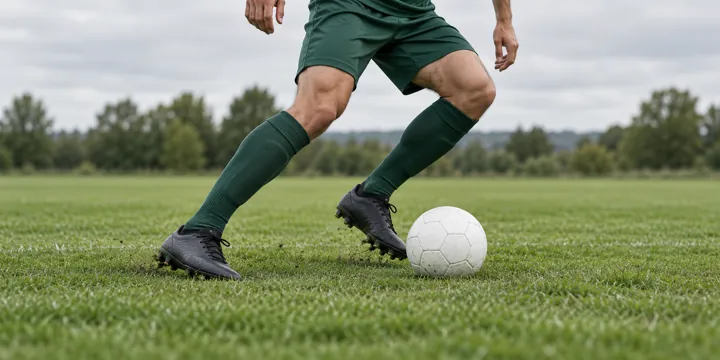
Position is a useful test plan, not a shoe category
Strikers sprint, stop, receive under pressure and shoot, but other players perform those actions too. A boot labeled “speed” is not inherently faster for every forward. Nike's boot-fit guidance explicitly says its football boots can be worn by every position. That is a useful corrective to lists that assign one shoe family to all strikers.
Position can still help you prioritize a try-on. If you often run behind defenders, pay attention to heel security during a short acceleration and stop. If you play with your back to goal, check whether the forefoot feels stable when turning and whether a seam or lace ridge bothers you as you receive and pass. If you take set pieces, compare upper feel when striking a ball. These are individual comfort observations, not evidence that a model adds shot power, accuracy or goals.
A winger who plays as a forward might value a different upper feel from a central target player. Neither preference overrides field compatibility. Write down your usual playing surface and the fit problem you had in your previous pair before looking at marketing labels.
Choose the sole for the ground you actually use
Start with the exact field. On firm natural grass, consider firm-ground (FG) models listed for that surface. On artificial grass, consider artificial-grass (AG) or a multi-ground (MG) model if the manufacturer explicitly approves the pitch and the facility allows it. Short, dense synthetic turf often calls for turf (TF) shoes; an indoor court needs a suitable non-marking indoor outsole. A muddy, yielding natural-grass pitch may require soft-ground (SG) studs if venue rules allow them. These are categories, not a guarantee that every model fits every field bearing the same broad name.
Ask the venue how its surface is classified. “Artificial turf” can mean a long-pile soccer field or a short carpet, with different outsole needs. Check the model's outsole description and studs, but do not guess approval from a photograph alone. Our FG versus AG guide explains the common grass distinction. If the pitch becomes soft after rain, compare FG and SG separately.
Fit both feet before comparing features
Measure both feet and use the manufacturer's chart for the exact model. Try the shoes with the socks and any approved ankle support you use in matches. Stand with your weight on both feet. Your toes should not be crumpled against the front, and the sides of your forefoot should not experience sharp pressure. Slight toe movement is normal; excess length can cause sliding when you brake. Your heel should stay seated when you walk and make a controlled turn.
Test the larger or more difficult foot first, then verify the other. Tight laces can mask a midfoot shape mismatch for a moment, but they do not create missing toe width. A longer size may relieve side pressure while adding dangerous movement inside the shoe. Try a different last or width option instead of relying on length alone. Our four-zone fit check separates toe, forefoot, midfoot and heel issues.
If a boot feels painful or numb in a short indoor try-on, do not buy it on the promise it will “break in” enough. Materials may soften, but a fundamentally wrong size or shape is not a break-in project. A gradual break-in routine is for a correctly fitting new pair, not a painful one.
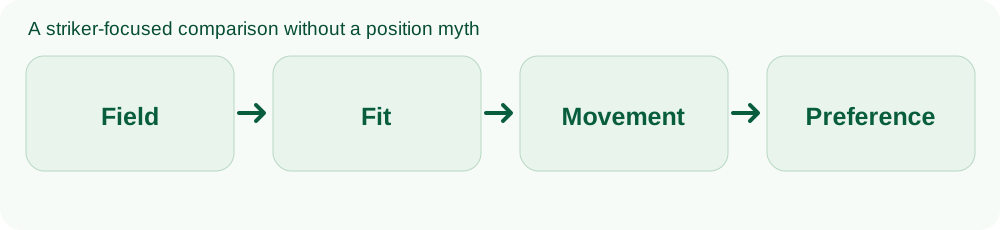
Run the same short test in every candidate pair
Where a store or safe trial permits, test each pair in the same socks with similar lacing tension. Walk, jog a few steps, make a short controlled acceleration, stop, turn both ways and take a few touches of a ball. Do not perform a maximal sprint in a shop. If you cannot test with a ball, the fit and movement steps still reveal obvious problems.
| Action | Feel for | Reason to reconsider |
|---|---|---|
| Short acceleration | Heel stays seated | Heel lift or toes jamming forward |
| Stop and turn | Foot stays centered | Sliding across the insole or forefoot pinch |
| Receive and pass | Comfortable contact across the upper | Seam, lace or stiff panel presses the foot |
| Controlled strike | Upper feel you can tolerate and repeat | Distraction or discomfort at the contact area |
Use the same sequence for each pair; changing socks, lacing or movement makes the comparison less informative. Your observation is about comfort and control in that brief trial, not a measured improvement in match performance. A shoe may feel different after a full session, which is why return terms and a gradual first use matter.
Upper feel, laces and weight come after fit
Some forwards like a thin, close upper that lets them sense the ball. Others prefer a more padded contact area. Neither preference is universally better for finishing. Compare how the material feels over your toes and instep without assuming a texture will make shots more accurate. The outsole and fit must already be right.
Laced shoes give you an obvious way to adjust tension over different parts of the foot. A laceless shoe can feel smooth over the instep but must hold your foot securely without that adjustment. Test both if you are curious; do not treat “laceless” as a performance claim. Our laced versus laceless guide explains the practical trade-offs.
Weight is easy to compare on a product page but difficult to interpret by itself. A lighter boot that causes heel lift or pressure is a poor choice for that player. A heavier boot that fits and is permitted on the surface may feel better across a match. If the two candidates both pass your checks, let upper feel and weight guide a personal preference rather than pretending to rank their goal-scoring potential.
Three buying situations
One natural-grass field, two comfortable FG pairs
Compare both in the same short movement test. If one is lighter but the heel lifts while stopping, choose the secure pair or keep searching. The result is a fit decision for that player, not a verdict on every boot in the line.
Artificial grass for training, natural grass for matches
Check whether an exact maker-approved MG model covers both venues and whether both facilities permit it. If not, consider appropriate separate outsoles. Do not force an FG shoe onto a pitch where the maker or venue advises against it to save the cost of a second pair.
Buying online for a player with a wide forefoot
Request the model code, size guidance and return terms. Compare the dimensions and shape with a comfortable current shoe. When it arrives, try it indoors with match socks and repeat the fit test before field use. Our wide-feet guide explains why simply sizing up can create heel slip.
What to ask before paying
- Which exact field or surfaces does the manufacturer approve for this outsole?
- What are the model code, size chart and available width or shape options?
- Can I inspect the outsole and upper with clear photos if I am ordering remotely?
- What is the return policy after an indoor try-on?
- If I buy just one pair, what is the total price and delivery option for my country?
Those questions make a seller's answer useful. “Best for strikers” without a model, size, field and return terms is not enough to make a purchase decision. If the player is a child, involve them in the fit check and allow for the current foot size rather than buying a pair so large that it slips. The parent buying guide covers that separate issue.
Common questions
Do strikers need lightweight cleats?
No. A lighter pair may be a personal preference, but it still needs to fit securely and suit the field. Weight alone does not prove better speed or finishing.
Are “speed” boots only for forwards?
No. Marketing families are not position restrictions. Players in any position can choose a model that fits their foot and field.
Do different studs make shots stronger?
There is no basis for claiming that from a stud label alone. Studs mainly concern the connection with an approved playing surface; comfort and fit remain important.
The practical answer
Choose a striker's cleats by field and foot first. Then use repeatable striker-relevant movements to compare the pairs that remain. Treat upper feel, lacing and weight as preferences you can actually observe, not promises of extra goals.
Sources and scope
This guide combines published manufacturer guidance and editorial decision steps. It is not a hands-on test of a particular bootswave product. Product instructions and venue rules for your exact model take priority.
Ask about a product
You can ask about one pair or one jersey. Tell us the style, size, delivery country and your question; we can confirm options and price. Message bootswave on WhatsApp or use this form.
Published: · Updated:
