WIDE-FOOT FIT GUIDE
Soccer Cleats for Wide Feet: Fit Checks and Width Options
For wide feet, start with the correct length and find where the shoe presses: toes, forefoot, midfoot, or instep. Compare a model whose shape accommodates that area, then verify that its heel still holds during movement. A longer size alone often leaves the pressure point and adds sliding.
Published: September 19, 2026 · Updated: November 1, 2026

Quick Reference
- Measure both feet while standing
- Mark the exact pressure zone
- Compare model-specific fit guidance
- Keep a secure heel at the correct length
- Try both shoes with match socks
- Reject numbness or persistent pinching
START HERE
Locate the width problem before shopping
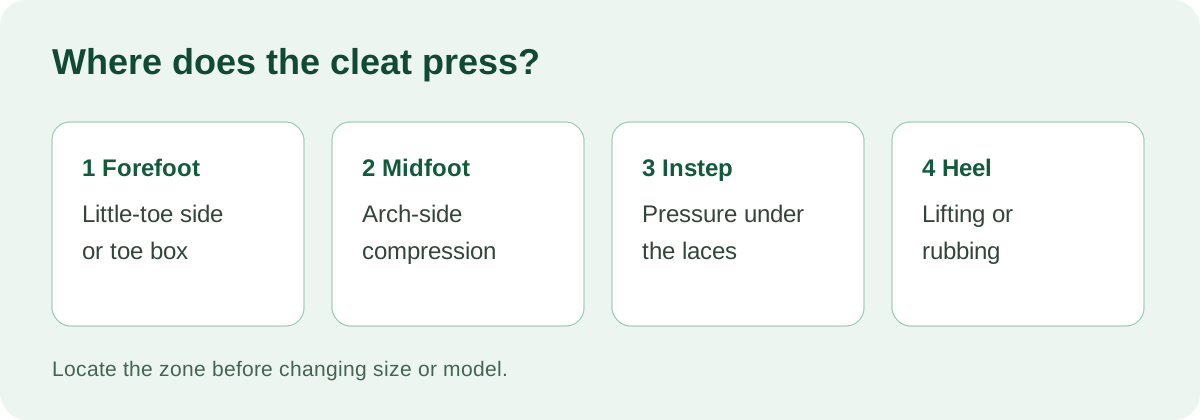
“Wide feet” describes several different fit problems. Pressure at the little-toe joint suggests a narrow forefoot shape; pressure over the laces points toward instep volume; squeezing at the arch points toward the midfoot. A heel that moves in a larger size is a different problem again. Record the location, because a shoe that is roomy across the toes may still be tight over the instep.
Measure both feet while standing, heel against a wall, and start from the longer foot. Nike’s soccer size chart explains how to measure foot length and warns that the centimeter value printed on a box is not the same as measured foot length. Use the exact model chart as a starting point, then test actual fit. If one foot is noticeably broader, fit the broader foot without leaving the narrower foot loose.
Write down what happened in the last pair: which side hurt, whether the pain appeared immediately or after play, and whether laces or a wider sock changed it. That record gives you a practical comparison when trying a new model; it is more useful than buying every shoe advertised as “wide-friendly.”
MODEL SHORTLIST
Treat brand fit guidance as a shortlist, not a ranking
Manufacturer guidance can narrow the search, but it cannot tell you which model is best for your foot without a try-on. adidas’s buying guide describes how upper construction and fit vary across lines. Nike’s size chart establishes length sizing, while its individual product pages describe each model’s intended fit. Check the current product description rather than assuming every Tiempo, Phantom, or Mercurial fits identically across generations.
| Candidate to compare | Why it belongs on a shortlist | What you still need to test |
|---|---|---|
| A model offered in a true wide-width option | Its actual width designation is more specific than a reviewer’s “wide-friendly” label. | Confirm the width option exists in your size and outsole; check heel hold. |
| A laced model with a rounder forefoot | Laces can adjust instep pressure while the shape gives toes room. | Check both the upper and the sole edge under the little toe. |
| A softer-upper model | It may conform more than a rigidly reinforced upper. | Do not rely on painful break-in; seams and plate width still matter. |
These are selection types, not bootswave test winners or stock promises. A current model can be compared only after checking its manufacturer’s surface label, size chart, return terms, and your own fit. If you need a specific recommendation, send us your foot length, pressure zone, field type, and a photo of a previous pair’s wear pattern.
FIT TEST
Keep the foot inside the shoe and the shoe under the foot
With match socks on, lace each shoe at normal playing tension. Stand and check that the longest toe has comfortable clearance without the foot sliding forward. Look down at the forefoot: if the upper bulges far past the outsole edge or the little toe rests on the sidewall, more upper softness alone may not solve the shape mismatch. At the same time, a wide forefoot does not require a wide heel.
- Stand and take several steps in both shoes. Locate any pressure rather than judging only overall tightness.
- Rise onto the balls of the feet and crouch lightly. Recheck the toe box and the top of the foot.
- Walk quickly, stop, and change direction if the store permits. The heel should remain controlled.
- Wear the pair for a few more minutes. Reject a pressure point that grows, numbness, or sharp pinching.
A snug football fit is different from compression that hurts. If you loosen the laces enough to relieve the instep but the heel then lifts, the shoe’s volume distribution is wrong for you. Try another shape instead of forcing a larger size. If you cannot try the shoe before buying, confirm the seller’s return policy and keep the shoe clean during a permitted indoor fit check.
UPPER AND LACES
Use adjustability for fine tuning, not a structural mismatch
Laces let you change tension locally across the top of the foot. For a high instep, start with even, moderate tension and reduce pressure at the tightest eyelets while keeping the heel and ankle area secure. Our lacing guide shows practical adjustments. A laceless boot has fewer ways to correct a pressure zone after purchase; choose it only if its original volume already matches.
Leather may soften with wear and some synthetic uppers also become more pliable, but neither should be bought with the expectation of curing numbness or forcing the foot onto a narrow plate. The extent of change depends on lining, stitching, overlays, and the model. Read Do Soccer Cleats Stretch? before treating break-in as a sizing strategy.
Use the same test on every candidate. Do not compare one pair with thin socks and another with match socks, or a laced model worn loosely against a laceless model worn tightly. Consistent conditions make the pressure differences meaningful.
PRACTICAL DECISION
Compare width without sacrificing length or hold
Width is not a single number. Two players with the same forefoot circumference can experience different pressure because one has a taller instep and the other has a broader toe shape. In a fitting session, locate the first place that feels restricted. A squeeze across the metatarsal heads points to forefoot volume; pressure on the top under the laces points to instep volume; toes touching the front point to length. Changing length to fix either width problem can introduce heel movement.
Try two candidate models in the same size, with the socks used for matches. Stand and spread your toes naturally, then walk, turn gently and stop. Check whether the upper bulges over the sole edge, whether the heel rises, and whether one side of the foot is forced onto the plate rim. The promising pair should retain its shape and hold without requiring you to loosen the laces until the midfoot floats. Repeat the test on both feet because the larger or wider foot sets the minimum fit requirement.
When buying remotely, ask for internal length or a model-specific size chart and a top-view photograph of the exact shoe. Width labels and reviewers' “wide fit” descriptions are useful shortlists, but they cannot replace your own test. Confirm the return condition before trying on an outdoor surface.
FINAL DECISION
Choose the pair that passes all three checks
The purchase decision needs three passes: the labeled outsole suits your field, the length and forefoot shape suit your foot, and the heel stays secure during movement. A comfortable upper on the wrong playing surface is not a good purchase; nor is an AG or FG plate that squeezes the foot. Use the soccer-shoe collection for surface categories, then ask about an individual pair if you need size or availability details.
If two models both pass, compare return terms, replacement availability, and price. A higher price is not evidence of a wider fit. Note which specific model and size worked: labels such as “regular” or “wide-friendly” can change between models and seasons. Players with ongoing pain, unusual swelling, or recurring injuries should seek qualified medical advice instead of treating shoe choice as a diagnosis.
FAQ
Frequently Asked Questions
Should I size up for wide soccer cleats?
Use measured length and the model chart first. If the correct length pinches at the side while a longer size slips at the heel, change the shape or width option instead of adding length.
Are leather cleats automatically better for wide feet?
No. Leather can soften, but lining, stitching and the soleplate limit how much the fit changes. The initial fit should not be painful.
Are laceless boots a poor choice for wide feet?
Not necessarily. They work when the opening and instep volume already match, but laced models usually provide more local adjustment.
How can I tell whether the problem is width or instep height?
Side pressure near the little-toe joint suggests forefoot shape; pressure on top under the laces suggests instep volume. Both can occur together.
What should I send bootswave if I want one pair?
Send your measured foot length, usual size, exact pressure zone, field type and the model you are considering. We can discuss available options and price by inquiry or WhatsApp.
SUMMARY
Fit the pressure zone without losing heel hold
Keep the right length, locate the tight area, compare the current model’s actual shape, and reject pain or heel movement during a short movement test.
For the basic sizing sequence, read How Should Soccer Cleats Fit?.
ONE-PAIR QUESTION
Ask About a Pair and Your Size
OTHER ARTICLES