NATURAL GRASS OUTSOLES
Firm Ground vs Soft Ground Cleats: FG or SG?
Choose FG cleats for natural grass over firm, supportive soil. Consider SG only when the natural ground is soft enough for longer studs to enter and release, and your venue permits the exact stud design. A rainy forecast alone does not tell you which outsole to wear: check the soil before you play.
Published: September 19, 2026 · Updated: November 1, 2026

Quick Reference
- FG: firm natural soil
- SG: soft, yielding natural soil
- Rain alone is not a field test
- Compare the whole stud layout
- Check venue rules and stud condition
- Avoid SG on hard or synthetic ground
THE DIFFERENCE
FG and SG solve different ground problems
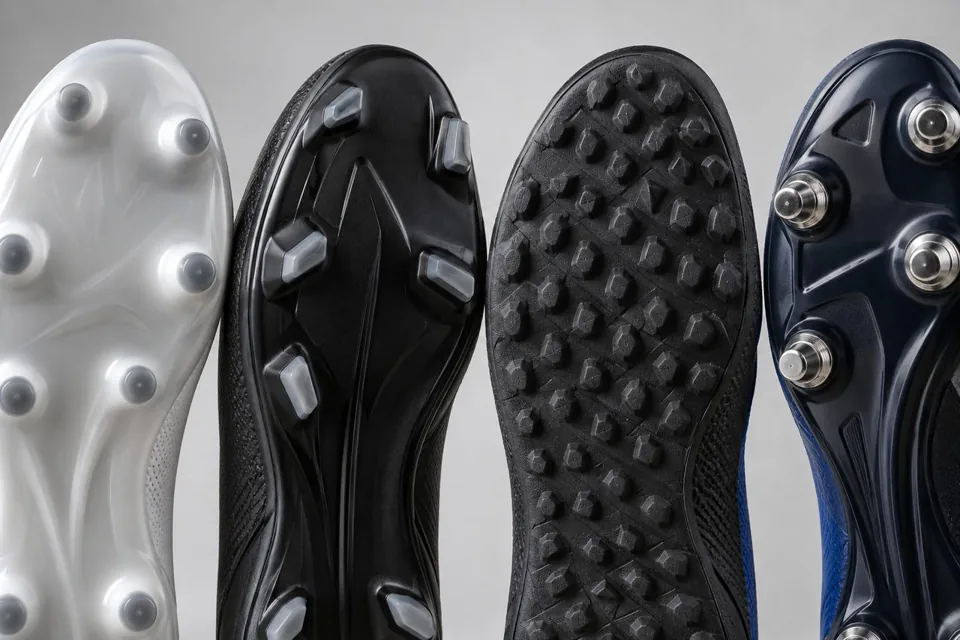
Both labels refer to the outsole's intended ground, not the upper's quality or the player's level. Nike's football shoe guide describes FG plates for short, comparatively dry natural grass and SG plates for damp, muddy natural pitches. adidas likewise separates firmer grass from soft or muddy grass. These are category descriptions; the maker's instructions for the exact model still matter.
| Check | FG | SG |
|---|---|---|
| Intended ground | Natural grass with firm support underneath | Natural grass with soft, yielding soil |
| Typical outsole | Multiple fixed molded studs | Fewer, often longer studs; some are detachable |
| What to inspect | Worn or uneven fixed studs | Loose, missing or sharp studs as well as the full plate |
| Wrong-field clue | Studs cannot find purchase in deep mud | Long studs do not enter a hard base comfortably |
The table shows common designs, not a specification for every shoe. SG does not automatically mean metal: some models use mixed or different stud materials. Conversely, a metal tip does not by itself tell you whether a particular venue approves the shoe. Our stud-type guide explains how to identify fixed and detachable construction.
FIELD CHECK
Look beneath the grass before choosing
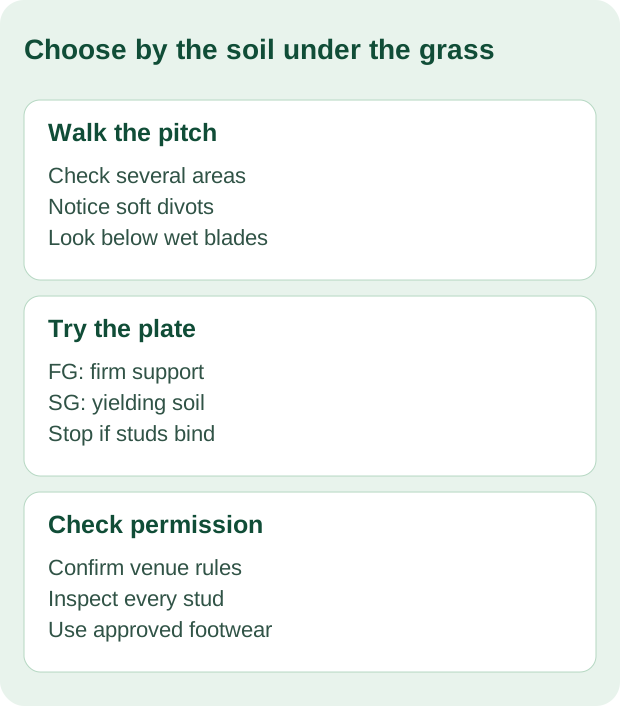
Walk several parts of the pitch before warm-up. A goalmouth may be soft while the center is firm; drainage, shade and wear can change the soil across one field. Look for standing water, deep divots and mud that holds a footprint. Then press the outsole gently into the turf. The useful question is whether the studs enter the soil and release when you lift and turn, rather than whether the blades of grass merely feel wet.
Use a controlled warm-up to check traction and foot pressure. If an FG plate skates on a deeply yielding patch, the available grip may be inadequate. If an SG plate feels perched on a compact base, long studs may be the wrong choice even after rain. Stop if the shoe catches unexpectedly, the sole rocks, or a stud is damaged. These are practical observations, not a laboratory traction or injury test; the same model can behave differently with soil, wear and weather.
A thin wet top layer over hard earth is the common trap. It can look muddy but still offer little depth for long SG studs. Equally, a dry surface after several days of rain may still yield underneath. Check the field you actually have, then confirm the shoe maker's surface label. The diagram below turns that check into a short sequence.
RULES AND CONDITION
Confirm that the exact studs are allowed
Inspect the sole before every match. Look for missing or badly worn studs, sharp edges, loose screw-in studs and a separating plate. A damaged stud is a problem regardless of whether its label says FG or SG. If the shoe has removable studs, use only the maker-approved replacement type and fitting method; a generic stud may not seat correctly.
IFAB Law 4 prohibits dangerous equipment but does not give a universal rule that all metal-tipped studs are banned. A competition, facility, school or coach may impose narrower footwear rules, so ask them before buying or playing. A referee can also require dangerous equipment to be corrected. Do not infer permission from another field's policy or from a product listing.
FG and SG are natural-grass categories. For artificial grass, do not assume either sole is suitable because it worked on a wet natural pitch. The article Can You Wear Soccer Cleats on Artificial Turf? covers the separate synthetic-field decision.
PRACTICAL DECISION
Make a match-day decision from the ground, not the forecast
Rain alone does not convert an FG field into SG. Look at the ground where players actually accelerate and turn. A firm pitch may be wet on the surface yet still support the foot; a soft pitch allows the sole to sink noticeably. Ask the venue or coach about footwear rules before bringing removable studs. A referee can reject equipment that is dangerous under IFAB Law 4, and a facility may set more specific stud restrictions.
For a player who usually trains on firm grass but has occasional muddy away matches, an FG pair remains the everyday choice. SG is worth considering only if those softer conditions recur and the exact outsole is permitted. Carrying both pairs may avoid forcing a firm-ground plate into mud or a long-stud plate onto hard ground. If the game moves to artificial grass, restart the decision: neither “FG” nor “SG” alone confirms suitability for that pitch.
Check removable studs before travel. Confirm each is seated correctly and none is loose, missing or excessively worn; never improvise with an incompatible replacement. After the match, clean the threads and outsole according to the maker's instructions and dry the boots with airflow. The practical question is not “Which label is better?” but “Which intact, permitted plate matches today's actual ground?”
SG is also not one universal stud setup. Some products use replaceable metal-tipped studs, while other configurations differ, and competition rules can restrict particular designs. Read the exact model specification and inspect every stud rather than relying on “SG” on the box. If the ground is merely damp over a hard base, long studs may feel uncomfortable and unnecessary. When in doubt, ask the venue and compare both permitted pairs during the warm-up, stopping if one causes pressure or catches unexpectedly.
BUYING DECISION
Choose for your usual field, then plan for exceptions
If you mostly play on maintained natural grass that supports your weight, FG is the relevant first category to examine. If you regularly play on genuinely soft, muddy natural soil and the venue allows the studs, an SG option may be useful. A player moving between firm and muddy pitches may need two approved outsoles; one aggressive SG sole is not a universal solution. For a mixed schedule that includes artificial grass, check the exact model's approved surfaces rather than treating the FG label as permission.
Fit remains separate from ground category. Try the candidate pair in match socks, check toe space and heel hold, and make controlled turns on an allowed surface. Buying the correct stud category does not fix a shoe that pinches or slides. The four-zone fit check gives a repeatable method without claiming that every brand uses one shape.
Buying one pair through bootswave is possible by inquiry or WhatsApp. Send the field type, the shoe or video you mean, your size and delivery country; we can confirm the available model, size and price. Do not infer stock, stud configuration or venue approval from an illustrative image alone.
FAQ
Frequently Asked Questions
Can I wear SG cleats after any rain?
Only if the natural soil is soft enough for the exact sole and the venue permits it. Rain can wet the grass while the base remains firm.
Are all SG soccer cleats metal-studded?
No. Designs vary; some use detachable or mixed studs. Inspect the exact outsole and ask about local restrictions.
Can FG cleats work on a soft pitch?
They may lose purchase when the soil yields deeply. Check the actual field and the maker's guidance, rather than assuming an FG plate works everywhere.
What if the field has both firm and muddy areas?
Check the areas where you will play, the venue rules and the sole's behavior during a controlled warm-up. No outsole removes all differences across a mixed pitch.
SUMMARY
Match stud depth to the soil
FG suits firm natural grass; SG is for natural soil that yields enough for longer studs, when those studs are permitted.
For a synthetic surface, use the separate FG vs AG comparison.
PRODUCT QUESTION
Ask About One Pair or a Team Order
OTHER ARTICLES