STUDS AND SURFACES
Soccer Cleat Stud Types: Molded, Detachable and Metal
Soccer cleat studs differ in shape, material, number and whether they can be removed. A fixed molded plate is common for everyday firm-ground or artificial-grass models; detachable or metal-tipped studs usually belong to specific soft-ground designs. Choose the complete outsole for the real field, then check the venue's rules.
Published: September 28, 2026 · Updated: November 1, 2026
Quick Reference
- Molded means fixed to the plate
- Detachable studs fit only a compatible design
- Metal is not a universal upgrade
- Shape alone does not determine surface use
- TF uses many short rubber lugs
- Inspect the full sole and venue policy
CONSTRUCTION
Separate fixed studs from replaceable systems
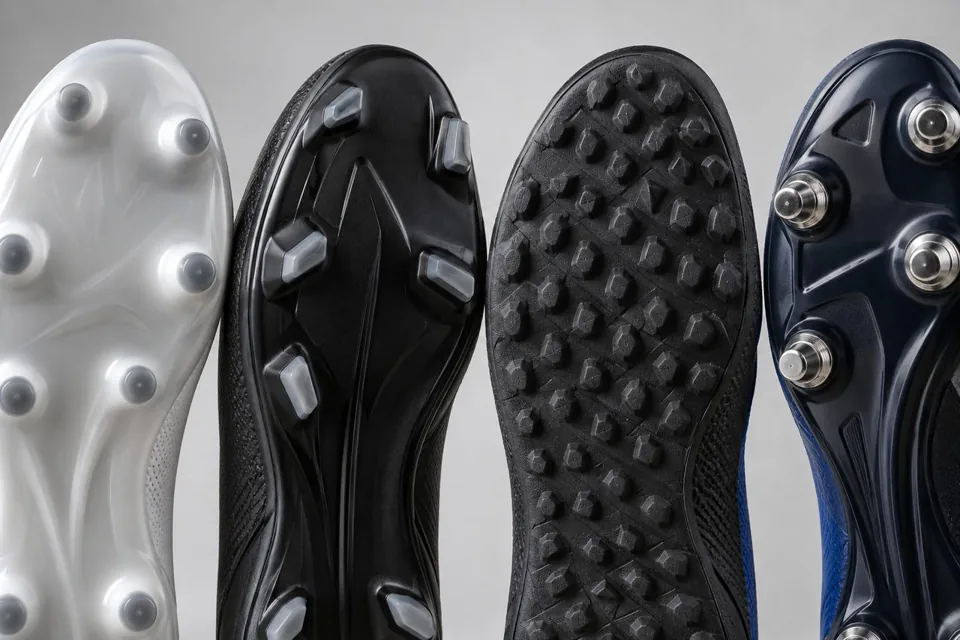
Molded studs are part of the outsole assembly and are not designed to be unscrewed individually. They can be rounded, bladed or mixed, and appear on many FG, AG and multi-ground designs. A detachable system uses compatible replaceable studs in a plate made for them. Some soft-ground boots use metal-tipped studs or a mixed set, but the material does not tell you the correct field by itself. Nike's shoe guide describes soft-ground plates with some detachable metal studs for damp, muddy fields; that statement applies to those models and conditions.
Examine how the parts attach rather than assuming a silver stud can be removed. Do not try to unscrew a molded stud or install a component because its thread looks similar. An aftermarket stud can change projection, balance or secure attachment. Use only the exact maker-approved set for the exact plate, and follow its installation instructions. If the sole edge is separating or a fixed stud is cracked, a replaceable-stud kit cannot repair that underlying damage.
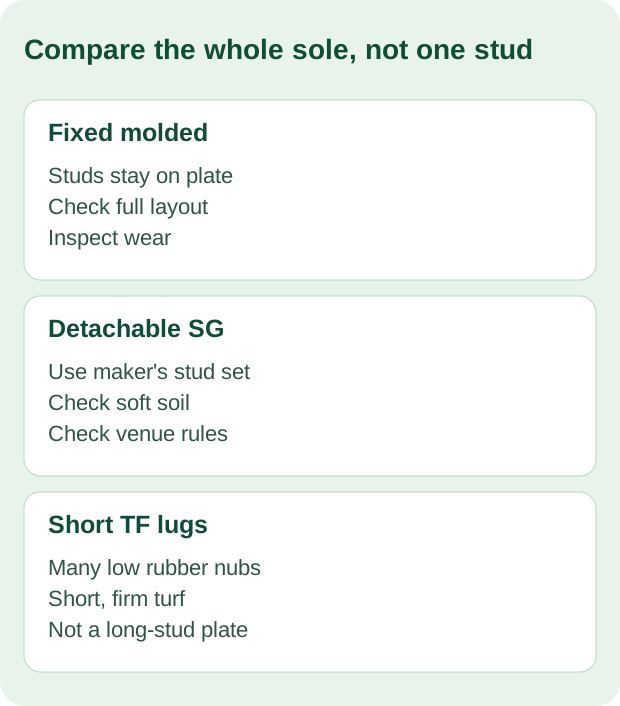
A practical first decision is therefore fixed versus detachable, followed by the model's stated surface use. The graphic shows the categories, while the product label determines what the real pair is made for.
SHAPE
Conical, bladed and mixed shapes work as a plate
Conical studs have a rounder footprint; bladed studs have a longer edge; many plates mix shapes and orientations. Mizuno's stud guide describes these design intentions, but it does not prove that every conical shoe is safer for turning or every blade makes a player faster. The number of studs, spacing, material, length, plate stiffness and the ground all matter together.
Compare two soles from the same intended surface category, ideally in the exact sizes you might buy. Notice whether long studs concentrate pressure under the forefoot when standing on that ground. During a gentle permitted try-on, the shoe should neither slip unexpectedly nor feel as if it catches excessively when you turn. This is a personal check, not a lab test or an injury-prevention guarantee. Fit matters separately: an outsole can be correct for the field while the upper squeezes your foot.
Do not infer a sport or position from the stud silhouette alone. A goalkeeper, defender or forward still needs a surface-appropriate sole and a shoe that holds the foot. Marketing about "aggressive" traction cannot replace the maker's field designation.
FIELD
Use field hardness and product guidance before material
| Field you actually use | First outsole category to check | Stud check |
|---|---|---|
| Firm natural grass | FG | Fixed molded plate approved for that model |
| Soft, yielding natural soil | SG if permitted | Compatible longer or detachable system |
| Longer artificial grass | AG or approved MG | Exact model's synthetic-field guidance |
| Short, firm carpet turf | TF | Many low rubber lugs rather than long studs |
This is a starting map, not permission to ignore the facility. adidas explains its FG and AG categories by field type, while individual products may offer several plate versions. A wet surface is not automatically soft ground; the soil under the wet top layer may remain firm. Read FG vs SG for that decision, or FG vs AG when comparing natural and synthetic fields.
Some venues prohibit metal studs or restrict longer studs. IFAB Law 4 requires equipment to be non-dangerous but does not itself give a blanket approval for every metal component or a universal ban on metal tips. The competition, facility and referee may apply additional requirements. Ask before buying or arriving for a match.
PRACTICAL DECISION
Read a stud plate in the order that matters
First determine where the shoe is intended to be used. A photograph of round, bladed or mixed studs cannot override the manufacturer's surface guidance or a venue's rule. Next look at the entire pattern: number and spacing of contact points, length, placement at the heel and forefoot, and whether studs are fixed or removable. Those features work together with the plate and field. Isolating one “conical” or “bladed” label does not establish how the boot will grip or release.
For removable studs, identify the correct compatible replacements and inspect each fastening before play. A loose, missing or sharp-edged stud is a reason to stop and repair the shoe. A fixed stud can also wear unevenly; compare left and right soles after cleaning. Do not drill, trim or replace a manufacturer's stud design with an unapproved part merely to make it fit a different field.
Finally test the pair for comfort on the approved surface. Notice concentrated pressure under the foot and any unusual catching or slipping during gentle movement. A player can use that observation to reject a poor fit, but it is not a scientific ranking of stud shapes or injury risk. If the venue is ambiguous, send it a photo of the plate and ask for its written footwear guidance before game day.
Consider two plates with the same number of round studs. One may place contact points differently at the forefoot or use a different plate stiffness, so the shared stud shape does not prove identical feel. Likewise, a mixed pattern cannot be reduced to the word “bladed.” This is why a stud-type chart should narrow the questions you ask, not rank all boots. Confirm surface approval first, then try the exact model and inspect its condition.
INSPECTION
Check removable studs and wear before play
Turn the clean shoe over and inspect every stud, the plate around it and the outsole edge. For a detachable system, confirm each component is the maker-approved type and securely installed according to that manufacturer's directions. Do not mix lengths or positions casually, and do not invent a tightening force. For a molded system, look for broken or severely worn studs and cracks around their bases. For a TF outsole, check whether lugs are worn down unevenly.
Check again after a muddy match because soil can hide damage. A sharp burr, loose stud, cracked plate or separating sole is a reason to stop using the pair until the problem is resolved. The referee may reject dangerous equipment under Law 4. Avoid presenting a general guide as a promise that a specific used or modified pair will pass inspection.
If buying one pair, send bootswave the surface you use most, your size, the exact outsole version you want, and your delivery country. Use the form below or WhatsApp to confirm an available option and price. Photos of the sole can help us identify a model; an image cannot prove field permission or condition after wear.
FAQ
Frequently Asked Questions
Are molded soccer studs plastic?
Many fixed molded studs use polymer or rubber compounds, but material varies by model. The defining feature is that they are not individually removable.
Are metal soccer studs always banned?
No universal ban appears in IFAB Law 4, which prohibits dangerous equipment. A competition, venue or referee can apply additional requirements, so check the actual rules.
Can I replace a broken molded stud?
A molded stud is not meant to be unscrewed individually. Ask the maker or a qualified repairer whether the damaged plate can be addressed; do not improvise a replacement.
Are conical studs better than blades?
Not in every shoe or on every field. Compare the complete approved plate, fit and actual ground instead of judging a single stud shape.
SUMMARY
Choose the plate, then inspect its studs
Fixed, detachable, rounded, bladed and metal-tipped studs describe construction; the exact field, product version and local rules determine suitability.
PRODUCT QUESTION
Ask About One Pair or a Team Order
OTHER ARTICLES