ARTIFICIAL TURF ELIGIBILITY
Can You Wear Soccer Cleats on Artificial Turf?
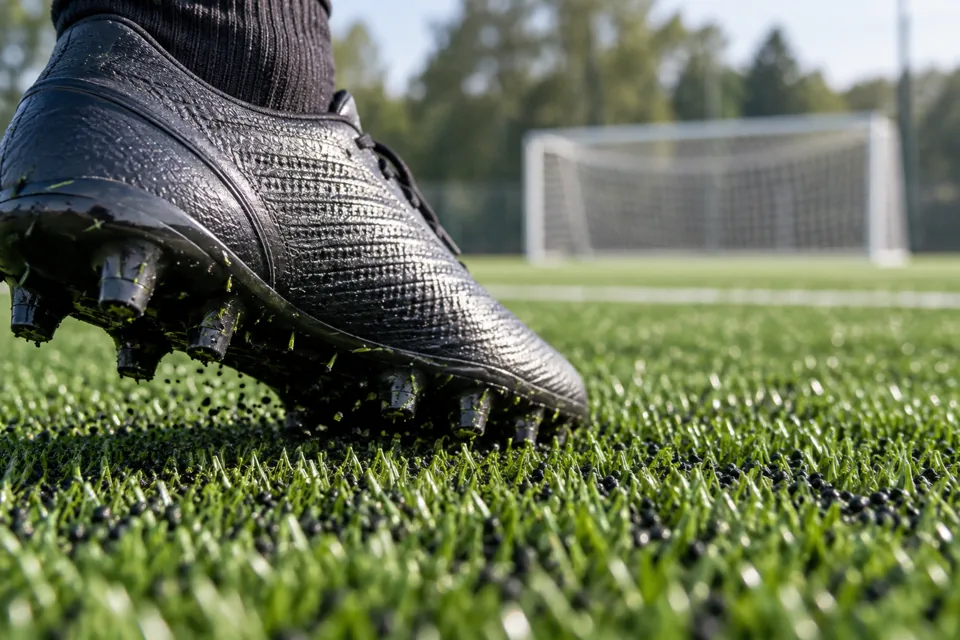
Yes, you can wear some soccer cleats on artificial turf. On compatible longer artificial grass, an AG outsole or a manufacturer-approved MG model may work. On short, hard carpet-style turf, check TF shoes instead. The exact product label and venue rule decide whether your current pair belongs on that field.
Published: September 19, 2026 · Updated: November 1, 2026
Quick Reference
- Yes, when the shoe and field match
- Longer artificial grass: check AG or approved MG
- Short hard turf: check TF
- A plain FG label is not automatic approval
- Read venue rules and inspect the actual sole
- Stop for sharp stud pressure or catching
THREE-CHECK ANSWER
Confirm field, shoe and permission before playing
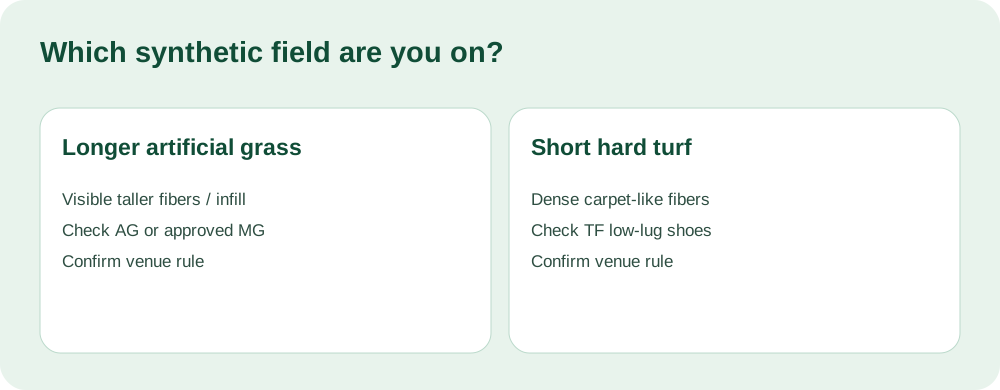
Start with the field rather than the word “turf.” Is it longer artificial grass with infill, or a short, firm carpet-like surface? Next read the exact shoe’s outsole label and intended-surface list. Finally ask the operator or league what footwear it permits. You need all three answers; passing only one does not make the pair suitable.
| Field you see | Shoe category to check first | Why the answer is conditional |
|---|---|---|
| Longer artificial grass, usually with infill | AG or a specifically approved MG/FG-AG model | Exact field construction and product approval vary. |
| Short, shallow, hard synthetic turf | TF shoe with many low rubber lugs | Studs can sit on top and concentrate pressure. |
| Hard indoor court | Flat, non-marking indoor shoe | A turf or studded outsole may breach court rules. |
| Unknown or heavily worn surface | Ask the operator before choosing | Appearance alone may be misleading. |
adidas’s cleat guide separates FG, AG, MG, turf and indoor categories by intended playing surface. Its description is a starting point; your exact model and venue can be narrower. Avoid assuming a molded sole is allowed simply because a sign bans only metal studs.
WHAT ABOUT FG?
An FG label alone does not give a universal yes or no
FG is primarily a firm natural-grass category. Some venue policies accept molded FG studs on certain synthetic fields. The Surrey FA 3G footwear guide, for example, recommends both AG and some FG soles for its particular pitch, while excluding soft-ground studs and blades. That policy is a concrete counterexample to a blanket “FG is always banned” claim. It does not approve your FG shoe at another venue or establish its manufacturer’s intended use.
Check the product’s own guidance as well. Even if a field admits molded FG footwear, a specific FG stud layout can feel excessively grippy or uncomfortable on a firm synthetic base. Conversely, a shoe marked MG or FG/AG still needs its named surfaces checked. The FG versus AG guide explains the design comparison; this page is the practical eligibility decision for a field you plan to use now.
ON THE FIELD
Do a gentle fit and traction check, then stop for problems
When the product and venue checks pass, put the shoes on with your playing socks and make a short, controlled warm-up. Walk, accelerate lightly, stop and turn gently. Notice whether the heel stays in place, whether pressure is spread across the forefoot and whether the sole rotates without a sticking sensation. A foot that sits high on its studs on hard carpet turf is a sign to check TF footwear.
Change shoes if you feel sharp pressure under a few studs, unstable rocking, repeated catching when turning or unexpected sliding. Do not continue in a pair with damaged studs or a separating plate. These are practical stop conditions, not a diagnosis or proof that another outsole will prevent injury. A wet, dry or worn version of the same field may feel different, so reassess after the surface changes.
Do not use detachable metal or soft-ground studs on a synthetic pitch unless that exact surface, the manufacturer and the venue specifically permit them. Many facilities prohibit them to protect players or the field. A “no metal” sign can coexist with further rules on blades, stud length or approved outsole types; ask if it is unclear.
PRACTICAL DECISION
Three common fields that produce different answers
Case one: a deep, infilled artificial-grass pitch. Here the first question is whether the exact outsole is sold for that type of artificial grass. AG is an obvious category to inspect; MG may work where the manufacturer explicitly includes the surface. A generic FG label does not answer the question. The facility may also ban certain stud materials or lengths, so check its written rule before the first match.
Case two: a short carpet-like five-a-side field. People also call this “turf,” yet it is much flatter and harder than a long-pile pitch. Compare a TF shoe with small rubber lugs if the facility permits it. Do not move the answer from case one across merely because both fields are synthetic. If the field is indoors on a smooth court, verify whether a non-marking indoor sole is required instead.
Case three: a shared venue with worn or uneven areas. A booking page may say “3G” or “artificial” without giving enough detail to approve a specific boot. Contact the venue, ask what footwear is allowed and photograph the actual surface if needed. Then compare that answer with the complete model name and the manufacturer’s surface statement. If the two conflict, use a different approved shoe. This sequence gives a defensible answer for a particular match, rather than a blanket yes for every artificial pitch.
When asking a facility, a precise question works better than “Are cleats allowed?” Ask whether the pitch is long-pile with infill or short carpet, whether molded plastic studs are permitted, and whether metal or replaceable studs are excluded. Save the answer if you play there repeatedly. If you are buying for a child or a visiting team, share the venue rule with the seller alongside the outsole photo. That prevents a generic product recommendation from being mistaken for approval at that specific facility.
IF YOU NEED A PAIR
Buy for the pitch you use most often
If you train mainly on long artificial grass, compare currently available AG or approved MG versions of models that fit your foot. If you play on short hard turf, compare TF shoes. If you alternate between the two, do not assume one shoe works on both merely because both fields are synthetic. Write down the venue names and compare the precise surface descriptions with each manufacturer listing.
Fit still matters after the label check. A surface-correct shoe that pinches the toe or lets the heel slide is not a good purchase. Try both shoes with match socks and check the return policy if buying remotely. Our artificial-grass buying guide goes deeper into choosing AG, MG or TF; this page answers whether your existing cleats are usable.
Bootswave accepts one-pair inquiries through the form below or WhatsApp. Send a clear outsole photo, the shoe model, your field type, size and delivery country. We can confirm available alternatives and pricing, while the venue remains the source of its own footwear rules.
FAQ
Frequently Asked Questions
Can I wear molded cleats on artificial turf?
Sometimes. The shoe must be designed or approved for that surface, and the venue must accept it. Molded describes stud construction, not universal field suitability.
Can I wear FG cleats on artificial turf just once?
Check the exact manufacturer guidance and venue policy first. One session does not remove the chance of unsuitable pressure or grip.
Are AG and turf shoes the same?
No. AG is a studded category commonly aimed at longer artificial grass; TF usually uses many low lugs for shorter, harder synthetic turf.
What if the pitch has no footwear sign?
Ask the operator or coach and check the maker’s listed surfaces before play. Do not infer approval from the lack of a sign.
SUMMARY
Yes, when the field, shoe and rules all agree
A suitable AG or specifically approved MG cleat can work on longer artificial grass. Short hard turf often calls for TF instead; the exact venue and product decide.
For buying criteria, see Soccer Cleats for Artificial Grass. For the outsole design comparison, see FG vs AG Soccer Cleats.
FOOTWEAR QUESTION
Ask About One Pair or a Team Order
OTHER ARTICLES