SOCCER VS AMERICAN FOOTBALL
Soccer Cleats vs Football Cleats: Design and Rule Checks
Soccer and American football cleats are made around different movements and product lines. Many American football models have a front toe stud and more position-specific upper choices; soccer shoes emphasize a predictable ball-contact surface. For cross-sport use, check the exact shoe, playing surface and current competition rule. A toe stud is a clue, not a universal ban under soccer’s global Law 4.
Published: September 19, 2026 · Updated: November 1, 2026
Quick Reference
- Compare complete shoe models, not just color
- A football toe stud is common, not universal
- Soccer Law 4 requires safe equipment
- Local competitions may add restrictions
- Match the outsole to natural or artificial ground
- Test fit with the intended sport’s socks
DESIGN COMPARISON
A toe stud is one difference, not the whole answer
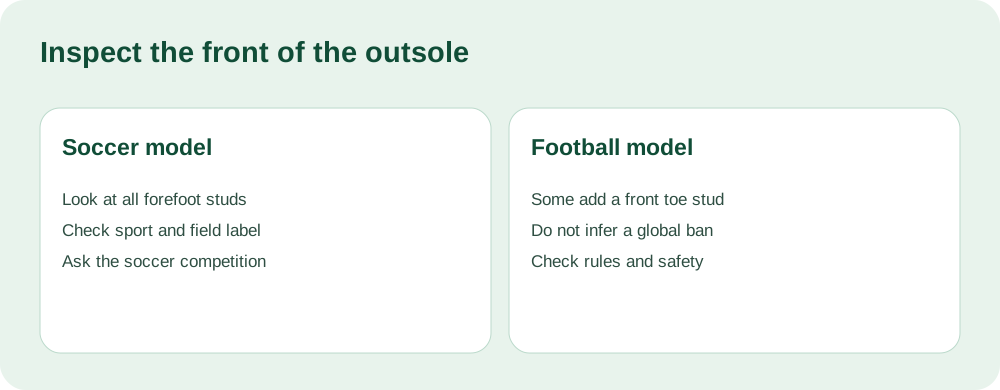
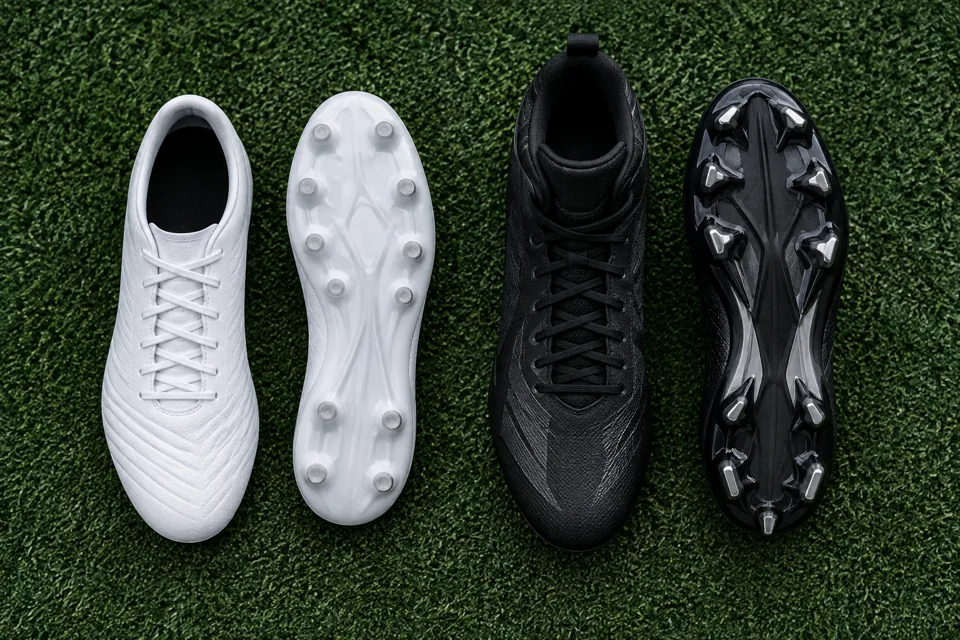
Under Armour’s sport comparison describes a front toe stud on many American football cleats, intended to help drive forward from a set position. Soccer cleats commonly have a different forefoot layout because ball contact and running in many directions are constant parts of play. But neither sport has just one sole pattern; inspect the exact shoe from underneath.
| Feature | Soccer product tendency | American football product tendency |
|---|---|---|
| Forefoot | Usually no prominent front-center toe stud | Many models add a toe stud for push-off |
| Upper | Designed with repeated foot-to-ball contact in mind | Can prioritize structure for position-specific movement and contact |
| Collar | Low or knit-collar options; fit varies | Low, mid and high cuts vary by role and model |
| Outsole | FG, AG, TF and other soccer surface versions | Football field surface and league-specific models |
| Can cross over? | Only if the other sport’s rules and field allow it | Only if soccer rules, field and fit allow it |
These are common product design choices, not measurements or a ban list. A low-cut football cleat can resemble a soccer cleat from above, while an outsole photo reveals a different toe and stud arrangement. The same brand may sell both sports in similar colors; product category and model number are more reliable than appearance.
THE SOCCER RULE
Law 4 asks whether equipment is dangerous
The IFAB Laws of the Game, Law 4 requires players to wear footwear and prohibits dangerous equipment. It also gives the referee authority to deal with unauthorized or dangerous gear. The current published global text does not state a blanket rule that any front toe stud automatically bans a shoe. Some product guides say that it does; that simplifies a rule that depends on actual safety, competition provisions and the official’s inspection.
Before a soccer match, check your league’s written equipment policy and ask the referee or organizer about the exact sole. Sharp, damaged, protruding or loose studs can create a safety problem regardless of whether a shoe was sold for soccer. A local league may specify permissible stud materials or sole shapes beyond the broad global rule. The permission at one tournament does not carry over automatically to another.
This is also why removing a toe stud yourself is a poor shortcut. Altering a plate could damage the outsole or leave an unsafe edge. Use a manufacturer-approved soccer model or a legitimate replaceable-stud design that the rules and venue permit.
THE FOOTBALL RULE
Soccer cleats can work in football only after a separate check
American football rules vary by organization, age group and competition. The NCAA football rules page provides its current rulebook, while school and youth leagues can have their own equipment provisions. Check the applicable season’s rule and speak with a coach or official before using a soccer pair in football. A soccer shoe’s missing toe stud does not by itself prove that it meets every football league’s requirements.
Performance needs differ by player. A kicker may value a clean striking area; a receiver may prefer a light, mobile feel; a lineman may want a more structured shoe. Those are reasons to compare models, not a claim that a particular shoe prevents injury or improves speed. The key questions are whether the cleat is legal, whether it holds the foot during the movement required, and whether its sole matches the actual field.
For flag football, check that league’s policy separately as well. “Flag” is not a single national shoe standard, and a turf venue may have tighter footwear restrictions than a grass field. If unsure, bring the specific pair to the organizer before the first game rather than finding out at kickoff.
SURFACE AND FIT
A legal shoe can still be wrong for the field or foot
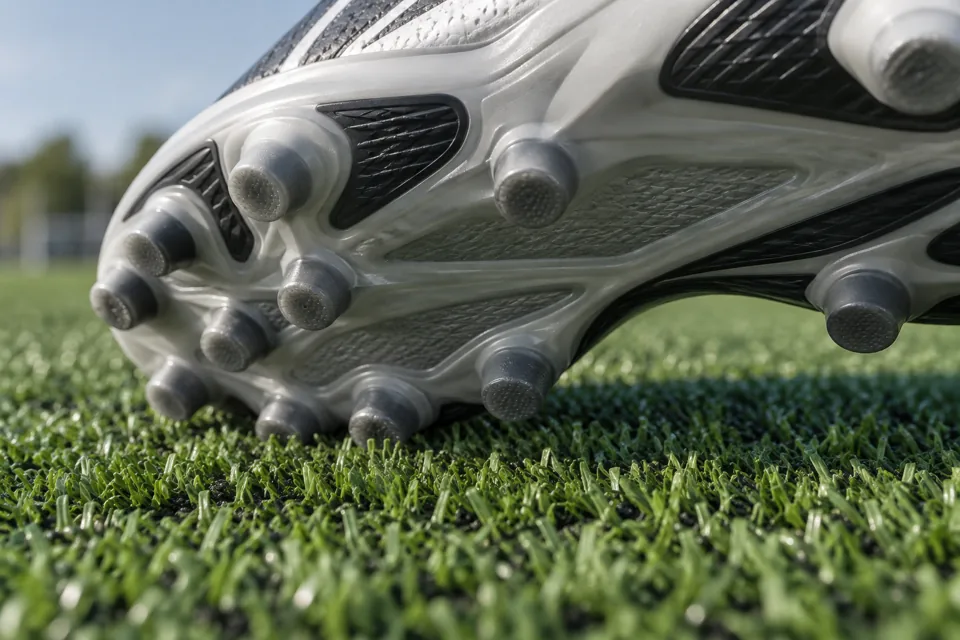
Even when an organizer permits the shoe, match its outsole to the ground. An FG soccer plate is built primarily for firm natural grass; an AG soccer plate targets compatible longer synthetic grass; a TF shoe uses low lugs for shorter, harder turf. Football products have their own surface guidance. adidas’s soccer surface guide explains why these soccer labels are not interchangeable. Read the exact model page and venue instructions rather than assuming both sports play on the same grass.
- Inspect the outsole for toe studs, broken parts, stud length and material.
- Find the exact model’s intended sport and field in the manufacturer listing.
- Read the governing competition and facility footwear rules.
- Try both shoes with your playing socks; check toe space, forefoot pressure and heel hold.
- Walk, stop and change direction gently before full-speed play. Stop if the shoe catches, rocks, pinches or slips.
Collar height alone is not an ankle-support test. Different uppers and lacing systems change hold, and a high collar cannot replace proper fit or clinical advice after an injury. The shoe should feel secure without numbness or toe compression. For a soccer-specific fit process, see How Should Soccer Cleats Fit?.
PRACTICAL DECISION
Check one shared pair against two separate games
A player who wants one pair for soccer and American football must pass two different checks. For soccer, confirm the outsole is approved for the actual field and has no dangerous projections or damage under IFAB Law 4. A toe stud is a common point of concern, but the law's safety principle and the referee's assessment matter more than a casual label. Ask the league or referee before game day if the outsole is unusual.
For American football, read that league's equipment rules and the field policy separately. Some positions or surfaces may favor a different boot design; soccer legality does not imply a football boot will fit the role. Check each shoe's current stud condition after switching sports. Mud, worn edges or a missing part can change the answer even when the model was acceptable when new.
Then test fit in the socks used for each sport. A shared boot that passes both sets of rules may still feel unstable during starts, stops or contact. If the player competes regularly in both sports, compare the cost and convenience of two appropriate pairs with the compromises of one. Do not buy from a product title alone; keep the exact outsole photo and ask both organizers about the specific pair.
BUYING FOR TWO SPORTS
Decide whether one pair is worth the compromise
If a child plays both sports for part of the year, start with each league’s written rule and both field surfaces. One pair may be possible for casual use when both organizers allow it and the sole suits both fields. Organized play, different surfaces, or a position that demands another shoe may justify separate pairs. Avoid buying the “universal” option solely because it is cheaper if it fails one of those checks.
Bootswave can quote an individual soccer pair through the form below or WhatsApp. Send the intended soccer field, size, model photo and delivery country. We can confirm availability and price; we cannot approve a shoe for your particular football league or soccer referee. Ask that organizer directly about eligibility.
FAQ
Frequently Asked Questions
Can you wear soccer cleats for American football?
Possibly, if that league and facility allow the pair, the sole suits the field and the fit meets the player’s needs. Check the applicable rulebook.
Are football cleats automatically illegal in soccer?
No blanket ban follows from the current global Law 4 text. Dangerous equipment is prohibited, and a competition or venue may impose more specific restrictions. Ask about the exact shoe.
Why do many football cleats have a toe stud?
Many models use one to support forward push-off. The stud is a product design feature, not a reliable single-test rule for every shoe.
Are football cleats always heavier?
No. Weight varies by model, size, upper and position. Compare actual product specifications rather than assuming all football pairs are heavier.
SUMMARY
Check design, rules and surface separately
Many football cleats differ at the toe and upper, but neither sport has one universal shoe design. Cross-sport use requires the exact competition rule, field approval and a secure fit.
For soccer-specific sole categories, see What Are Soccer Cleats? and the FG versus AG comparison.
FOOTWEAR QUESTION
Ask About One Pair or a Team Order
OTHER ARTICLES