FIRST-PAIR BUYING GUIDE
How to Choose Soccer Cleats: Field, Fit and Buying Checks
Choose soccer cleats in this order: identify the field you play on most, shortlist only outsoles approved for that surface, and try the exact shoe for secure fit without pain. Then compare price, return terms and the complete model version. Color, player position and marketing tier come later.
Published: September 21, 2026 · Updated: November 1, 2026
Quick Reference
- Name your main playing field
- Choose the matching outsole category
- Check the maker and venue guidance
- Measure both feet and try match socks
- Reject pressure, numbness or heel slip
- Compare exact version and total cost
STEP ONE
Identify the field before browsing models
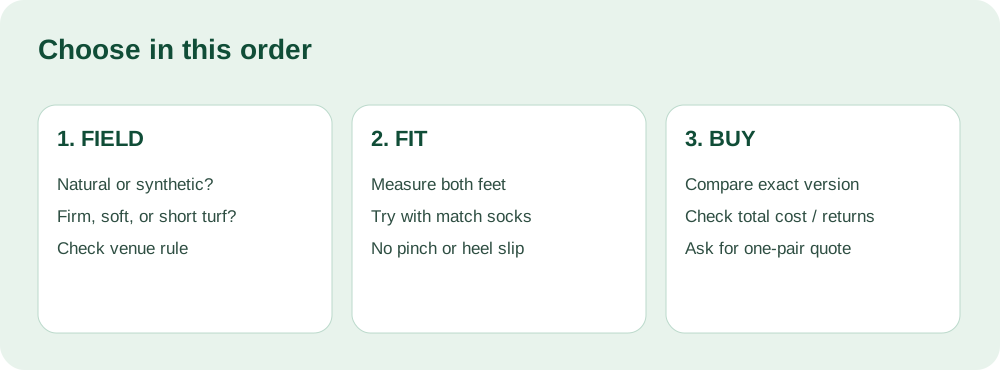
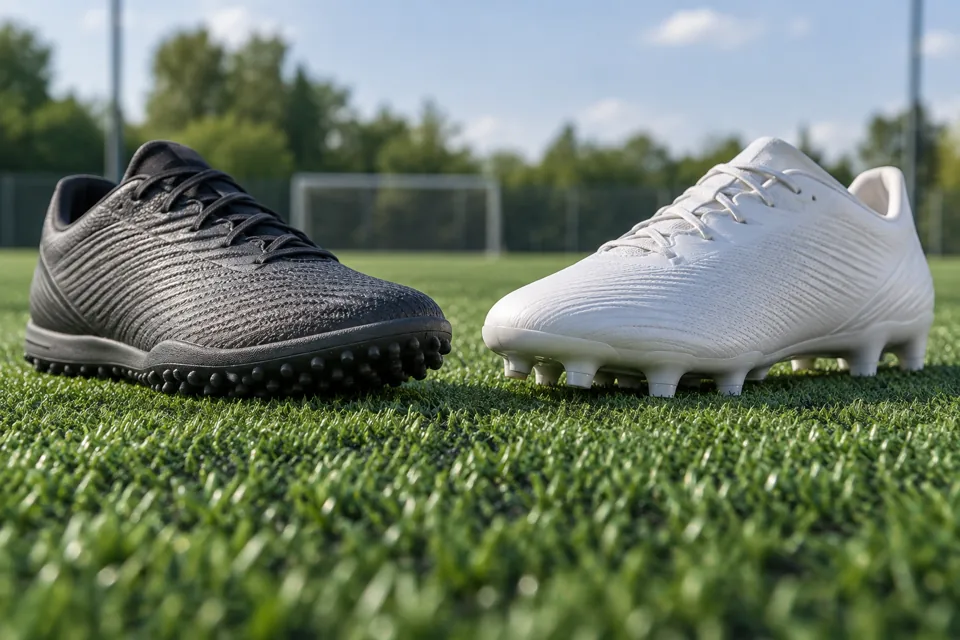
Ask where you will actually play most weeks. Firm natural grass, muddy natural grass, longer artificial grass, short hard synthetic turf and a smooth indoor court call for different starting categories. adidas’s soccer footwear guide links FG to firm natural grass, AG to suitable artificial grass, MG to the surfaces listed for a given multi-ground product, TF to turf and indoor soles to hard courts. The exact shoe and venue may narrow those broad categories.
| Field you play on | Category to check first | Before buying |
|---|---|---|
| Firm natural grass | FG | Confirm firmness and stud rules |
| Soft, wet natural grass | SG where permitted | Confirm detachable-stud policy |
| Longer artificial grass | AG or listed MG | Check model and venue approval |
| Short, hard synthetic turf | TF | Check dense low lugs |
| Smooth indoor court | IC or IN | Check non-marking requirement |
“Turf” is often used for both long-pile artificial grass and shallow carpet-like turf. Look at the fibers and ask the facility what it permits. For a detailed synthetic-field decision, read Soccer Cleats for Artificial Grass; for an existing shoe, use the artificial-turf eligibility check. If your schedule has both natural and artificial grass, inspect a real MG product’s named surfaces rather than treating MG as universal.
STEP TWO
Choose a sole within the approved category
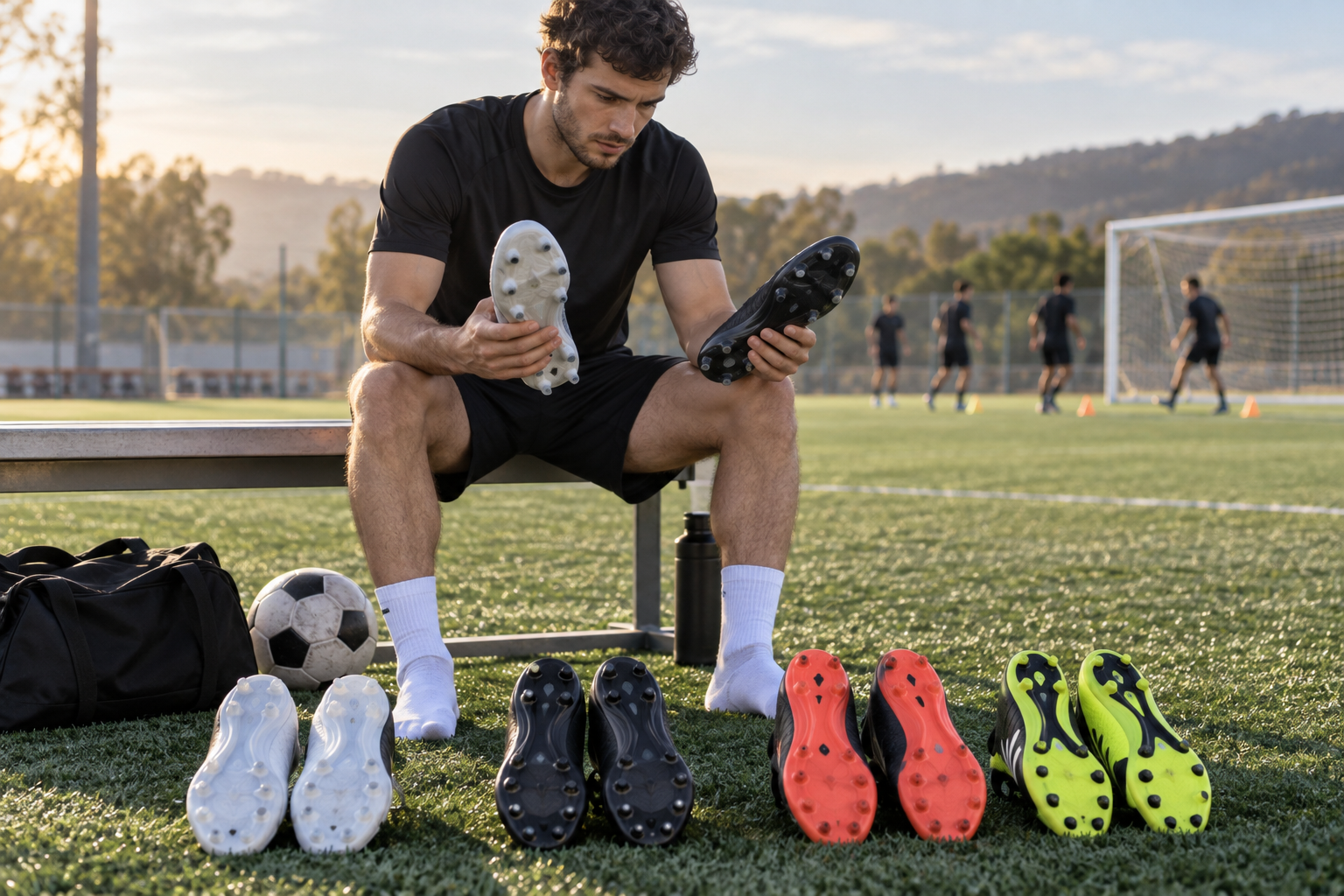
Once you know the field, inspect the full product name and the underside of the exact shoe. A family can have FG, AG and TF versions with similar uppers. The suffix and manufacturer description matter more than the colorway or a retailer’s shortened title. Nike’s soccer shoe guide also presents surface-specific sole options, showing why the same broad sport category is not enough.
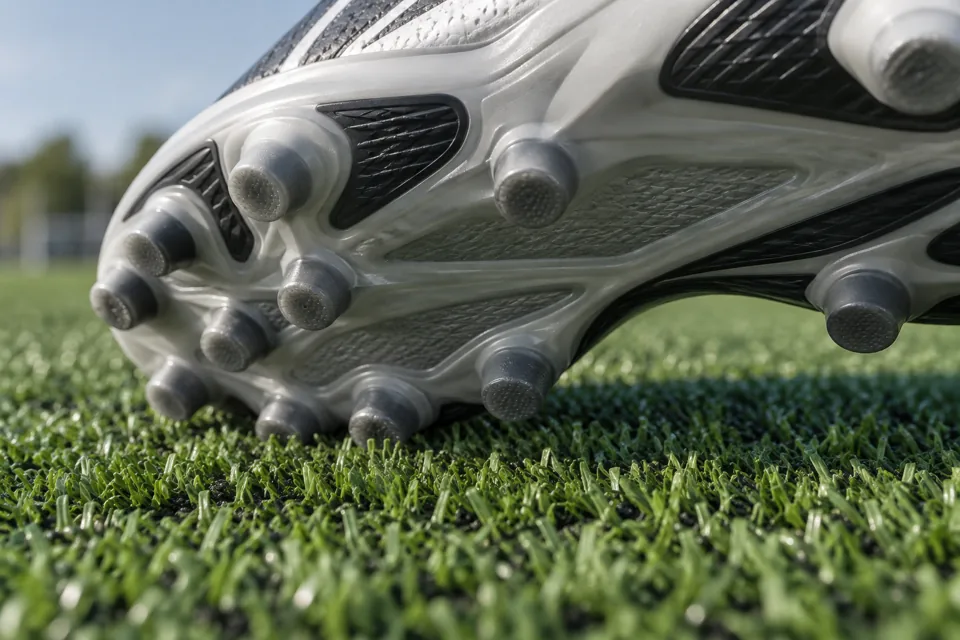
Do not judge the outsole solely by whether the studs are round or short. Number, spacing, length, material, plate stiffness and the field beneath them can all change underfoot feel. Check the venue policy before a match: metal or detachable studs and blades may be restricted even on fields where molded cleats are allowed. A product approved by its maker for a surface still needs to meet the local rule.
The practical test is simple. If the field is short and firm, compare TF shoes against studded cleats. If the field is natural grass but changes from firm to muddy, use FG versus SG. If it is longer artificial grass, compare AG and genuinely approved MG. Do not buy a lower-priced FG pair for an AG-only season just because it shares the same upper as the AG version.
STEP THREE
Measure for length, then test shape and heel hold
Measure both feet while standing, using the longer foot as the initial length reference. Nike’s soccer size chart shows how to measure foot length and distinguishes the foot measurement from the centimeter number printed on a shoe box. Use the relevant maker’s chart for your selected model. Size labels vary, and a chart alone cannot reveal whether the toe box or instep matches your foot.
- Put on the match socks you normally wear, then try both shoes fully laced.
- Stand and check comfortable toe clearance without the foot sliding forward.
- Walk, crouch lightly and make controlled side steps. The heel should stay seated.
- Locate pressure precisely: toes, little-toe joint, midfoot or top of the foot.
- Reject numbness, sharp pinching or pressure that grows over a few minutes.
Do not size up reflexively to fix width. Extra length can cause sliding while the forefoot remains squeezed. Compare a different shape or true width option; our wide-foot fit guide explains how to identify that problem. A soft upper may become more pliable, but no buyer should rely on painful break-in to make a narrow plate suitable. See How Should Soccer Cleats Fit? for a longer fit check.
MATERIAL AND FEATURES
Compare uppers only after field and fit are settled
Leather, synthetic and knit uppers can change touch and the feeling of flexibility, but construction varies by model. Stitching, overlays, lining, collar and laces can matter as much as the headline material. A model described as “speed” is not automatically a better fit for a winger; a “control” texture does not guarantee better shots. Compare the actual shoe while wearing your kit.
Laces offer a way to adjust instep tension. A laceless design can feel tidy over the ball but gives fewer fit adjustments if pressure appears. If you are uncertain, try both and move through the same steps rather than selecting by an advertisement. Read Laceless vs Laced Soccer Cleats for that specific tradeoff.
For a child, remeasure both feet before each purchase and fit to the current foot. Do not buy excessive growing room if it leaves the heel loose. For a team, collect sizes and field types after individual fit preferences are known; those purchasing details do not change the surface and fit decision that every player must pass.
PRACTICAL DECISION
Turn a broad shortlist into one defensible purchase
After identifying the field, choose two or three exact outsole versions that the manufacturers name for it. Record the complete model name, not only the upper family. If a listing has an FG version and an AG version, treating them as the same product can undo the surface decision. Ask the venue about any stud restrictions, especially if it describes several synthetic fields with one word such as “turf.”
Next measure both feet and test each candidate with match socks. Check toe length while standing, forefoot width after walking, instep pressure under normal lacing and heel hold during a controlled stop. A single “true to size” review cannot predict all four. Reject a pair with growing numbness or a sidewall that forces the foot over the edge of the plate, even if it is the most popular model.
Only then compare upper feel, color, tier and price. Make a simple two-column note: what you can verify now, and what remains unknown until you try the pair. Confirm total price, available size, shipping and return terms before paying. For a one-pair bootswave inquiry, send the field, size, preferred model and delivery country; request confirmation of the exact outsole. The best choice is a match among field, fit and terms, not a model that wins every internet ranking.
FINAL PURCHASE
Compare the whole cost and the exact version
Check the complete model name, surface suffix, size availability, shipping, returns and any customization before paying. A more expensive tier can use different materials or details, but price does not establish that it fits your foot or field better. Our US price guide shows dated retail examples and how to compare total purchase cost rather than treating a list price as the whole answer.
If ordering remotely, use the seller’s return terms to plan an indoor try-on without marking the outsole. Ask for a sole photo if the listing hides it. When a product page says only “soccer boots” and does not name its intended surface, do not infer AG or FG from its appearance. For bootswave, an individual player can request one pair through the form below or WhatsApp. Send the model or image, size, field and delivery country; we will confirm available options, price and next steps. You can browse the soccer shoe collection first, but it does not function as an instant checkout.
FAQ
Frequently Asked Questions
What is the first thing to check when choosing soccer cleats?
Identify the field you use most often, then check the exact shoe’s intended surface and your venue’s rules.
Should soccer cleats be tight?
They should feel secure without growing pressure, numbness, jammed toes or heel slip. Try both shoes with match socks.
Can one pair cover grass and artificial grass?
Sometimes. Check an MG or other dual-surface model’s specific listed fields and both venue policies; do not assume every FG shoe covers AG.
Do I need a position-specific soccer cleat?
No. Start with surface and fit. Position-themed features are secondary and should be judged on the actual shoe, not a general promise.
Can I buy just one pair from bootswave?
Yes. Ask through the on-page form or WhatsApp with the model, size, playing field and delivery country; bootswave will confirm availability and price.
SUMMARY
Field first, fit second, purchase details third
Choose an outsole for your real surface, verify that the exact pair fits without pain, then compare price, returns and availability.
Explore the soccer-shoe collection after the field and fit checks, or use the form below to ask about a single pair.
ONE-PAIR QUESTION
Ask About Availability and Price
OTHER ARTICLES