TF OR STUDDED CLEAT?
Turf Shoes vs Cleats: Which Should You Wear?
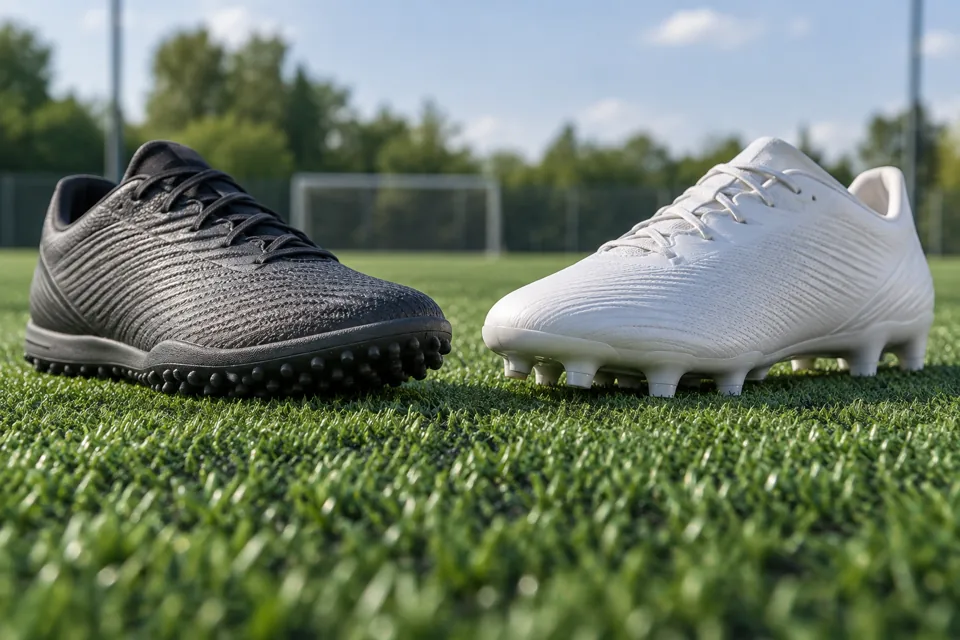
Choose TF turf shoes for short, firm synthetic turf. Choose an approved AG cleat for compatible longer artificial grass, or FG for firm natural grass. The key difference is how low rubber lugs or longer studs meet your actual playing surface, so check the product and venue before deciding.
Published: September 19, 2026 · Updated: November 1, 2026
Quick Reference
- TF has many low rubber lugs
- AG and FG are studded categories
- Short hard turf usually points to TF
- Longer artificial grass usually points to AG
- Firm natural grass usually points to FG
- Exact product and venue rules decide
THE COMPARISON
Lugs and studs meet the ground in different ways
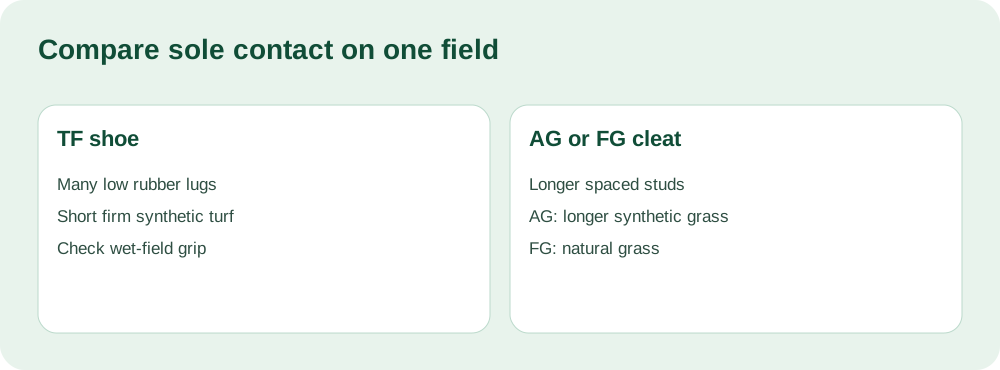
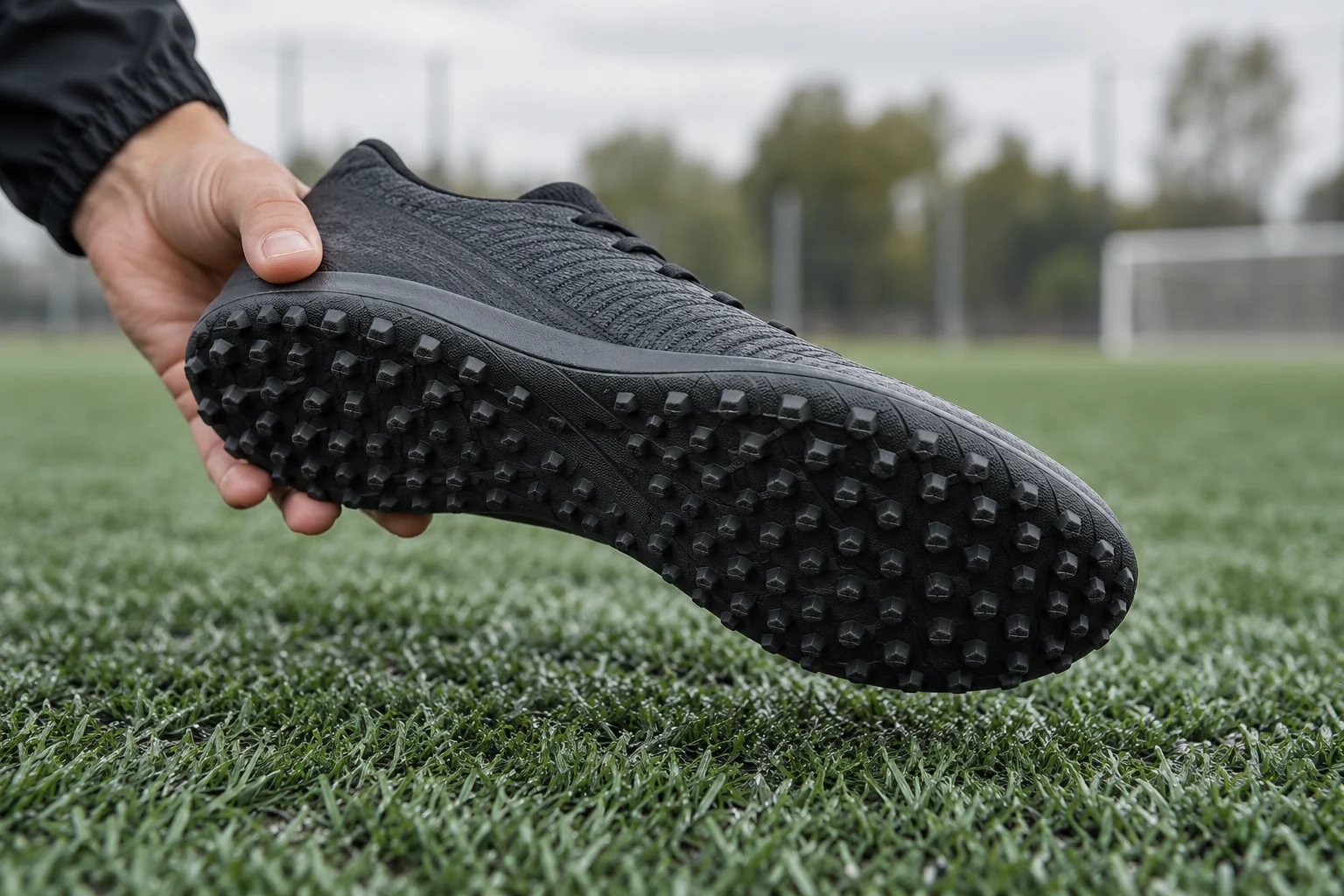
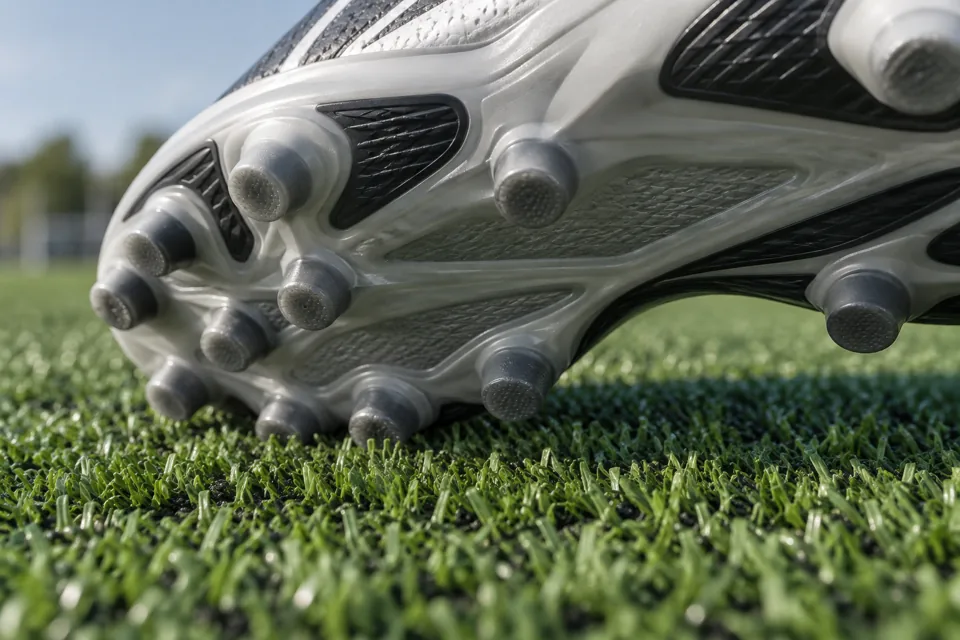
TF soles have many short rubber lugs spread across the bottom of the shoe. A studded cleat has more prominent projections arranged to engage the surface it names. An AG cleat and an FG cleat are themselves different: AG is marketed for suitable artificial grass, while FG starts with natural grass. adidas’s surface guide explains these categories and separates turf and indoor soles from studded designs.
| Question | TF turf shoe | AG or FG cleat |
|---|---|---|
| What is underneath? | Many low rubber lugs | More prominent studs, pattern varies |
| Best starting surface | Short, firm synthetic turf | AG: longer synthetic grass; FG: firm natural grass |
| On hard shallow turf | Low lugs can contact the surface | Longer studs may feel perched or pressured |
| On deeper grass | Limited penetration | Correct approved stud may enter the surface |
| Decision limit | Wet or worn turf can still reduce grip | Wrong stud category can still be unsuitable |
Neither side wins everywhere. A lighter shoe, softer upper or more cushioning cannot make the wrong outsole suitable for a field. Inspect the bottom and intended-surface wording of the exact model rather than relying on the family name or a photograph from above.
SHORT TURF
Choose TF when studs cannot enter a shallow field
Look at the fibers where you play. If they are dense and short and the base feels firm just below them, start by comparing TF models. A taller studded plate may sit above the field instead of entering it, leaving you with concentrated pressure or a rocking sensation. That is a field observation to check, not a guarantee that every TF product will grip every carpet-like pitch. Skechers’s surface guide identifies short older carpet-style turf as a TF use case.
Before buying, ask the venue whether it allows TF and whether it excludes other types of shoe. Some short-turf facilities prohibit long studs even when they are molded rather than metal. Check for water, slick patches or heavy wear too; a low-lug shoe can slip when the surface is wet or contaminated. Inspect your existing TF lugs for smooth wear, because a worn pair will not behave like a new one.
“Indoor turf” may be a shallow synthetic field inside a building. Its roof does not make it a smooth indoor court. Identify the floor beneath the game, then follow that venue’s footwear policy. A hardwood or other smooth futsal court generally calls for a flat, non-marking indoor sole instead of TF or studs.
LONGER GRASS
Choose the approved stud category for deeper fields
Longer artificial grass often has visible infill and more depth. Check an AG or explicitly approved MG product there, then confirm the exact field and shoe. A TF outsole may feel comfortable while failing to engage that longer surface as intended. The artificial-grass buying guide handles detailed AG-versus-MG purchasing; this comparison only tells you when low lugs or a studded plate should be the first shortlist.
Natural grass creates a separate choice. Firm, dry to slightly damp natural soil usually leads to FG. Soft, muddy ground may require a suitable SG design, subject to venue and competition rules. A TF shoe might feel fine on a dry, hard patch but its low lugs generally cannot replace an appropriate grass cleat in wet soil. See Firm Ground vs Soft Ground Cleats for the grass-specific distinction.
There are exceptions to simple slogans. A Surrey FA 3G facility guide recommends AG and permits some molded FG footwear on its own pitch; it restricts other soles. Its policy proves that venue rules differ, not that every FG shoe is fine on every synthetic field. Product approval and facility permission are both needed.
ONE-PAIR QUESTION
Use your actual schedule before buying two pairs
Write down the field you use for training and the one you use for matches. If both are the same short, hard synthetic surface, a well-fitting TF pair can be the main purchase. If one is short turf and one is long-pile artificial grass, compare the maker’s surface list carefully; one pair should not be assumed to cover both. If the second field is natural grass, verify whether a suitable multi-ground outsole actually names that natural field as well as the synthetic one.
- Identify each field by construction and current condition, not by a nickname.
- Check the complete product name and each listed intended surface.
- Confirm both facilities’ footwear rules, including stud material and shape.
- Try the shoe with match socks and test a few controlled stops and turns.
- If either field or fit check fails, choose another outsole or keep separate pairs.
Two pairs are not inherently better or necessary. They make sense when the surfaces and permitted categories differ enough that one approved outsole cannot do both jobs. Price, available sizes and how often you play on each field matter too. A cheap extra pair that pinches or slips is not a useful solution.
PRACTICAL DECISION
Use the venue description to avoid the wrong shoe
Imagine a booking page that says “artificial turf.” Before purchasing, ask whether it is a short carpet-like pitch, a longer-pile infilled field or a smooth indoor court. On short, hard turf, a TF outsole with many low rubber lugs is often the category to compare. On a longer-pile artificial-grass pitch, check an AG or specifically approved MG cleat. An indoor court may require a flat non-marking sole. The marketing word “turf” alone cannot distinguish these surfaces.
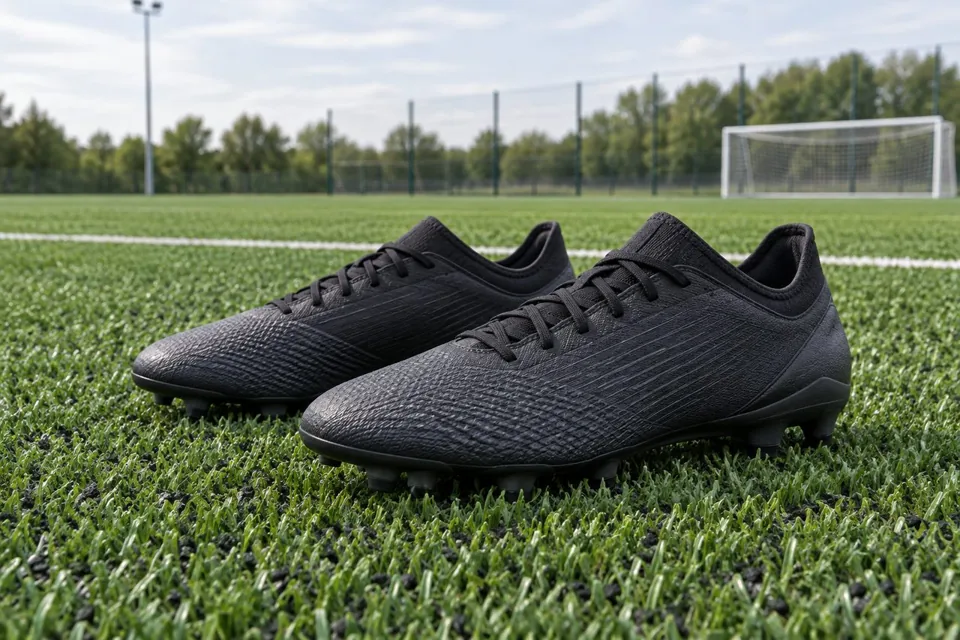
Inspect the actual outsole before paying. A low-lug TF shoe can look like a casual sneaker from above, and a studded AG boot can share the same upper as an FG version. Read the full model name and manufacturer surface guidance. If the venue has a footwear rule, apply it even when a product description seems broader.
During a gentle test on the permitted field, notice whether the shoe grips consistently, whether a stud concentrates pressure, and whether the heel remains stable. Stop if you feel unexpected catching or slipping. These are personal fit observations, not proof that one outsole type prevents injury. If your weekly schedule crosses short turf and natural grass, make the decision for both venues; two suitable pairs may be more practical than forcing one unsuitable plate into every match.
FINAL CHECK
Watch for pressure, catching and slipping
Once the shoe is approved for the field, wear it briefly during a gentle warm-up. TF should not feel like it skates across the surface; a cleat should not feel locked into it during turns. Stop if you notice sharp pressure under individual studs, a rocking sole, repeated catches, slipping, or heel movement. These observations tell you to reassess the shoe and field; they are not a claim that one outsole can eliminate injuries.
For an individual order from bootswave, share the field, model or screenshot, size and delivery country through the form below or WhatsApp. We can confirm available TF or cleated versions and quote a single pair. The field operator remains the authority on its own rules. If your question is only what TF means, see What Are Turf Shoes?.
FAQ
Frequently Asked Questions
Are turf shoes better than cleats on all artificial fields?
No. TF is a common match for short hard turf; longer artificial grass often calls for an approved AG or MG cleat.
Can turf shoes replace cleats on natural grass?
They generally offer less penetration on natural soil, particularly when it is wet. Check the exact product and field condition.
Can I use AG cleats on short carpet turf?
Do not assume so. Check maker guidance and venue rules; the studs may feel too high or pressured on a shallow hard surface.
Can one pair work on turf and grass?
Only if the exact outsole is approved by its maker and both venues for the two actual fields, and it fits comfortably.
SUMMARY
Let the real field settle TF versus studs
Choose low-lug TF for short firm turf, a suitable AG cleat for longer artificial grass, and FG for firm natural grass.
For an existing pair on a synthetic pitch, use Can You Wear Soccer Cleats on Artificial Turf?.
ONE-PAIR QUESTION
Ask About Availability and Price
OTHER ARTICLES