SOCCER CLEAT PRICE GUIDE
How Much Do Soccer Cleats Cost? Real US Price Examples
As a current US retail example, adult Nike soccer cleats listed around $100 for an Academy multi-ground model, $160 for a Phantom Pro artificial-grass model, and $260 for a Tiempo Elite artificial-grass model when checked on October 31, 2026. Those are examples from one brand, not a universal price range or bootswave’s prices.
Published: October 4, 2026 · Updated: November 1, 2026
Quick Reference
- Prices below are dated US examples
- Compare adult with adult, not kids’ models
- Match the outsole to your real field
- Check fit before paying for a tier
- Include shipping and return costs
- Ask bootswave for the actual one-pair quote
PRICE SNAPSHOT
What do real adult soccer cleats cost in the US?
The table gives a checkable snapshot, not a promise that every store has the same price. On October 31, 2026, Nike’s US Academy listing showed the adult Nike United Mercurial Vapor 17 Academy MG at $100. Its Pro listing showed the adult Phantom 6 Low Pro AG at $160. The US cleat listing showed the adult Nike United Tiempo Maestro Elite AG at $260.
| Example, US listing checked Oct. 31, 2026 | Listed price | What this does and does not show |
|---|---|---|
| Mercurial Vapor 17 Academy MG, adult | $100 | A multi-ground Academy example; not a price for every beginner shoe. |
| Phantom 6 Low Pro AG, adult | $160 | An artificial-grass Pro example; compare only after checking your field. |
| Tiempo Maestro Elite AG, adult | $260 | An artificial-grass Elite example; a premium price does not prove better fit. |
Prices, discounts, colors and stock can change after the check date. A children’s shoe, an FG version and a turf version may carry different prices even when the family name is similar. Reopen the product page before ordering; do not use this table as a live catalog or as a bootswave quotation.
WHY PRICES DIFFER
A higher tier changes features, not the size of your foot
Brands use different lines and tiers. Within a line, the upper material, plate design, finishing and styling may change, but price alone does not establish a measurable performance improvement for you. A player who needs forefoot room gains little from a costly boot that compresses the little toe. Likewise, a bargain FG model is poor value if your venue requires AG or turf shoes.
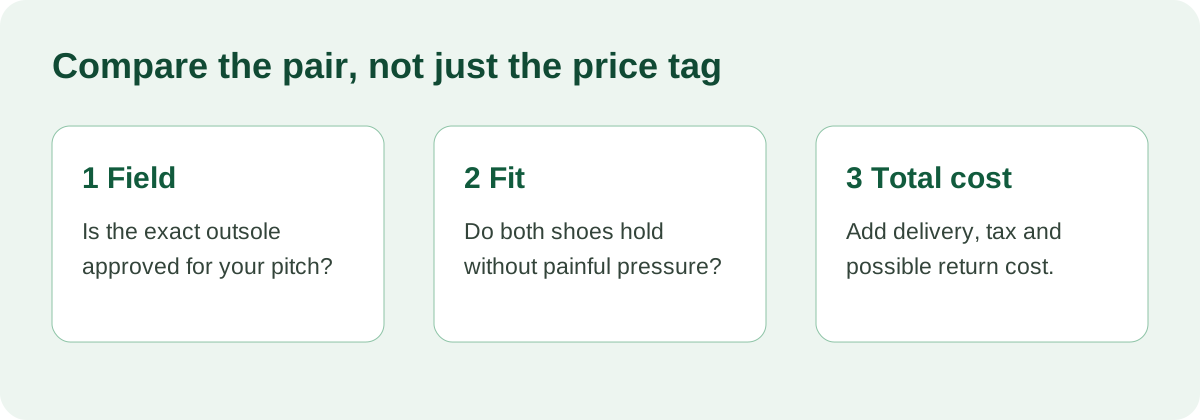
Compare two shoes with the same intended surface and approximate fit before comparing features. Start with the manufacturer’s field label; then test heel hold, toe room and pressure in match socks. Only after both shoes pass should you ask whether the higher-priced one provides a feature you will actually use, such as a preferred upper feel, more suitable closure, or a replacement option in your size.
Do not mistake a sale tag for a product category. A discounted Elite shoe may cost less than a full-price Pro shoe because of color, season or stock decisions. Check the exact model name and outsole, not only the tier. The general cleat-selection guide explains the surface and fit sequence in more detail.
TOTAL COST
Calculate what you will actually pay and use
For a one-pair purchase, the checkout price may not be the final cost. Add shipping, taxes if applicable, and any return-shipping charge. If the model is hard to return after an outdoor try-on, that uncertainty matters. Before ordering, confirm whether the seller allows a clean indoor fit check, which sizes are available, and who pays if the fit is wrong.
For your own comparison, divide the expected total cost by the number of sessions you realistically expect to use the pair. This is a budgeting method, not a predicted lifespan. For example, $150 across 50 sessions is $3 per session; if the outsole or upper fails early, the real cost rises. Do not invent a fixed replacement schedule: frequency, field abrasion, care and construction vary.
Inspect the pair before play. Check for separated bonding, damaged studs, a cracked plate, or a heel that no longer holds. Clean and dry the shoes according to their material guidance. Our cleaning guide covers a conservative routine. Keeping an unsuitable pair merely because it was expensive does not improve value.
BUDGET DECISION
How much should a beginner spend?
Set a budget only after identifying the field. A beginner needs an outsole allowed on that surface and a secure, comfortable fit; an Elite badge is optional. Use a current in-market listing to see what is available at the budget you can afford. The $100 Academy example above shows one adult option in one brand on the check date, not the minimum amount required to play.
Try the shoes with match socks, stand and move, and reject persistent pressure or sliding. If two pairs both work, choose the one with clearer return terms or the lower total price unless the extra cost buys a feature you can name. Parents should compare kids’ prices and sizing separately: adult examples in the table do not estimate youth cost, and buying excess length for growth can compromise fit now.
A second pair can make sense if you regularly alternate between materially different surfaces, but buying two pairs is not automatically cheaper. Check whether one manufacturer-approved multi-ground outsole covers both fields first, and follow your venue’s footwear rules.
PRACTICAL DECISION
Build a budget around one usable pair
Start with the price of the exact outsole and size you need, then add delivery, taxes and any return cost. A sale on the wrong plate is not a saving if your league field does not allow it. Similarly, a cheaper boot that cannot be returned after a fit problem may cost more than a slightly higher-priced option with clear terms. Compare total cost for one pair, not the headline price of a model family.
Match spending to frequency and the limiting problem. A new player on one field needs a surface-approved pair that fits; the highest tier is optional. A player training several times a week may value replaceability and consistent fit more than decoration or a signature colorway. If a child is still growing, measure now and choose a usable fit for the current season rather than buying so much extra space that the heel slips today.
When comparing tiers, write down only differences you can verify: outsole version, upper construction, closure, warranty or return policy, and available size. Retail price does not tell you whether an upper will fit your foot or last a specific number of matches. For a bootswave quote, send the exact model or a clear photo, size, delivery country and intended field; ask for the final price and order terms before deciding.
BOOTSWAVE QUOTE
How to get the actual price for one pair from bootswave
Bootswave sells to individual players as well as teams. Our article’s Nike prices are independent retail examples, not bootswave product prices. To request one pair, contact us through the form below or WhatsApp. Include the model or a screenshot, your size, the country for delivery and your playing surface; we can confirm available options, price and ordering steps.
If you are buying for a team, quantity, sizes and customization affect the quote, but those details are unnecessary for a single pair. Do not assume every photographed shoe is in stock or that a quoted price includes shipping until we confirm it. You can also browse the soccer-shoe collection to identify the surface category before asking.
FAQ
Frequently Asked Questions
Are expensive soccer cleats always better?
No. A higher tier may have different materials or construction, but the shoe still needs to fit your foot and match your field. The price alone cannot establish an advantage for an individual player.
Why does the same model appear at different prices?
Size, color, outsole version, retailer, country, promotion and stock timing can differ. Compare the exact model and final checkout cost.
Do children’s soccer cleats cost the same as adult pairs?
No. The examples in this guide are adult US listings. Check the separate youth listing for the current size, version and price.
Can I buy just one pair from bootswave?
Yes. Send an inquiry on this page or contact us on WhatsApp with the model, size, surface and delivery country; we will confirm availability and price.
What if a cheaper shoe fits better?
Choose the suitable fit and outsole. A lower price is not a problem when the shoe passes your movement check and meets the field rules.
SUMMARY
Use price as the final comparison, not the first filter
Current US examples span different tiers, but your useful price is the total cost of a pair that fits, suits your field and can be returned under clear terms.
Compare cleat fit and surface categories before requesting a one-pair quote.
ONE-PAIR PRICE QUESTION
Ask for Availability and Price
OTHER ARTICLES