WET-WEATHER FOOTWEAR
Are Soccer Cleats Waterproof? What to Check for Wet Matches
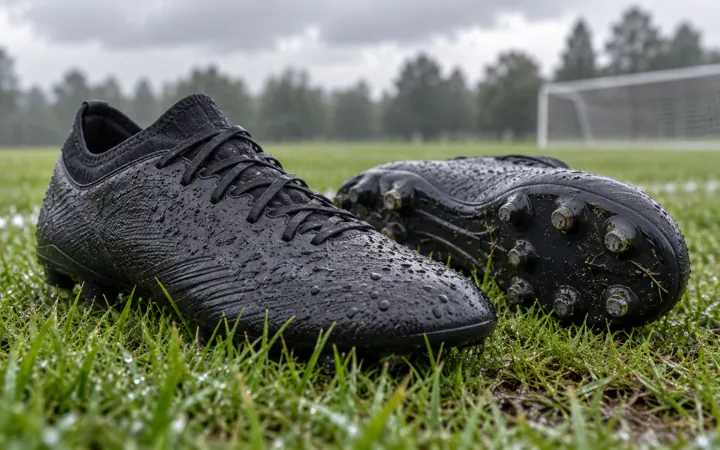
Most soccer cleats are not waterproof in the way a sealed rain boot is. Some uppers resist splashes or absorb less water, but moisture can still enter through the collar, tongue, lace opening and seams. For a wet match, check the exact model’s claims, choose the outsole for the actual ground, and plan to dry the shoes afterward.
By bootswave Editorial ·
Waterproof, water-resistant and quick-drying are different claims
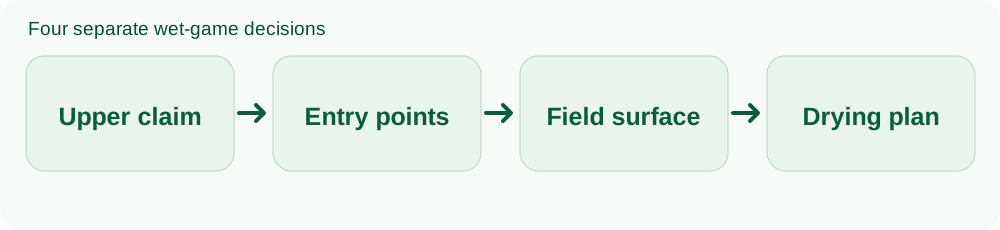
A waterproof shoe needs an effective barrier around the foot, including its material joins and openings. A typical low-cut soccer cleat is built for ball feel, fit and movement; its open collar means it cannot keep water out in every wet condition. A water-resistant or water-repellent upper may shed light rain for a period, yet puddles, soaked socks or prolonged play can still wet your foot. A material that dries quickly is about what happens afterward, not proof that it excludes water during a match.
Manufacturer descriptions are model-specific. adidas's soft-ground category mentions water-resistant uppers on some shoes, while its leather-upper cleat guidance discusses water-repellent synthetic alternatives and drying behavior. Those statements do not make every cleat from the brand waterproof. Read the exact product page and any care notes before making that assumption.
| Label or feature | What it may mean | What it does not prove |
|---|---|---|
| Water-resistant upper | Material may shed some surface moisture | Sealed collar, laces and seams |
| Water-repellent finish | Water may bead temporarily | Dry socks after a long wet match |
| Quick-drying synthetic | Material may hold less water after play | Water exclusion during play |
| Soft-ground outsole | Designed for some soft or muddy natural-grass conditions | A waterproof upper or universal stud permission |
Where rain and ground water reach your socks
Look at the shoe as a system. Water can run down your leg and sock into the collar. Rain can pass through a lace opening or tongue; splashes can reach stitching and joins. An upper that repels droplets at first may become wet after repeated contact with grass. A boot can therefore feel dry in a brief store splash demonstration and still leave your socks damp after ninety minutes.
Fit matters here as well. A very loose collar can leave a larger path for water and debris, but choosing a dangerously tight boot to close that gap is a poor trade. You still need a secure heel, enough toe room and a forefoot shape that does not pinch. A taller collar is also not a guarantee: its material and the transition around the ankle still leave possible entry routes. Use the same fit checks you would in dry weather.
Wet socks do not identify the entry point by themselves. They may have become wet from rain running down the leg, saturated ground, or moisture retained from a previous session. If this matters to you, inspect where the water appears first and compare a clean, fully dried pair of socks and shoes on the next similar session. This is an observation method, not a laboratory waterproofness test.
Wet grass changes the outsole question
Rain does not automatically turn every field into “soft ground.” A natural-grass pitch may remain firm beneath a wet surface, while another becomes muddy enough for a different stud configuration. On artificial grass, the correct answer depends on the exact pitch and the shoe manufacturer's approved surfaces; metal soft-ground studs are commonly inappropriate or prohibited. Check the facility or competition rules. Nike's soccer shoe guide organizes shoes by surface, including firmer and wetter natural-grass conditions.
Do not choose an SG outsole merely because the upper advertises rain protection, or a water-resistant FG shoe because the field has puddles. The upper and outsole answer different questions. Press a foot into the pitch where permitted, observe whether the ground yields, inspect the venue guidance and ask whether studs are restricted. If the ground differs from your usual field, review the specific model rather than assuming an acronym is a universal permission slip.
For a mixed season, you may need more than one appropriate pair if your fields differ substantially. An “all-weather” label is not a substitute for the model's outsole guidance. Compare firm and soft ground cleats before buying for natural grass, and use FG versus AG if artificial grass is part of your schedule.
Leather, synthetic uppers and coatings
Leather can feel comfortable to some players, but it also needs the care specified for that exact product. Some synthetics may resist initial wetting or dry faster than a more absorbent material. Neither material family settles the whole-shoe question; construction, seams, tongue and collar matter too. A treatment added later may change feel, appearance or breathability and could conflict with the manufacturer's care guidance. Do not spray an unknown product onto a new boot just to create a “waterproof” claim.
If a listing says “waterproof,” look for the scope of the claim: upper material only, a membrane, or the complete shoe? Check whether the product is actually a football cleat and whether its outsole is correct for your venue. Marketing language without a model-specific description is weak evidence. Ask the seller for the product code and original manufacturer page. If they cannot show what feature provides protection, plan as though your socks may get wet.
A practical routine before and after a rainy match
- Before: Check the field, local stud rules and forecast. Choose a permitted outsole first, then compare model-specific water-resistance descriptions.
- Pack: Carry dry socks and a separate bag for wet gear. This does not make cleats waterproof, but it improves the trip home.
- After play: Remove loose mud with a soft brush or damp cloth as the product instructions allow. Take out removable insoles if the maker permits.
- Dry: Open the shoes and let air circulate at room temperature. Avoid direct high heat that can harm materials, adhesives or shape.
- Before storage: Check the lining, insole and toe area for remaining dampness. A dry-looking exterior does not mean the inside is ready for a closed bag.
For detailed cleaning, follow the specific manufacturer's directions and our cleat cleaning guide. If persistent odor follows a wet game, the shoe-odor routine starts with thorough drying rather than perfume.
How to buy when you play in frequent rain
List your actual fields and how often they become muddy. Shortlist only models approved for those surfaces, in your size and with a comfortable fit. Within that shortlist, compare the upper's specific claims, ease of cleaning and drying instructions. If water resistance is the deciding feature, ask for its source in the manufacturer's description, not a reseller's generic tag.
Consider how a wet shoe feels after it has absorbed water, but do not assume a lighter dry weight predicts the answer. If a store allows a try-on, wear your match socks and perform a controlled stop and turn; do not rely on hand-feel alone. If ordering online, confirm the return policy before using the shoes outdoors. The most practical pair is one that fits and is appropriate for your surface, even if another pair advertises a stronger wet-weather slogan.
Common questions
Are leather soccer cleats waterproof?
Do not assume so. Check the exact model and care directions. Material alone does not seal the collar, tongue or seams.
Do waterproof cleats prevent slipping?
No. Water resistance concerns moisture; grip depends on a permitted outsole matched to the actual playing surface and conditions.
Should I use a hair dryer after rain?
Direct high heat can harm shoe materials or construction. Follow the maker's drying instructions and use gentle air circulation.
The practical answer
Expect wet socks in prolonged rain unless the complete shoe's construction and use conditions support a specific waterproof claim. Choose the correct outsole and fit, treat upper protection as model-specific, and dry the pair fully after play.
Sources and scope
This guide combines published manufacturer guidance and editorial decision steps. It is not a hands-on test of a particular bootswave product. Product instructions and venue rules for your exact model take priority.
Ask about a product
You can ask about one pair or one jersey. Tell us the style, size, delivery country and your question; we can confirm options and price. Message bootswave on WhatsApp or use this form.
Published: · Updated:
