SOCCER SHOE SOLES
What Does MG Mean on Soccer Cleats? Check the Field First
MG usually means Multi Ground: an outsole sold for more than one outdoor playing surface. It is a category label, not permission to wear that shoe everywhere. Match the exact model's surface guidance to your field and the venue's stud rules.
By bootswave Editorial ·
What the two letters actually tell you
“MG” is commonly short for Multi Ground. In its soccer cleat surface guide, adidas describes MG as combining some features of its natural-grass and artificial-grass outsoles. Its shoe category page says its MG shoes are made for natural and artificial outdoor surfaces. That explains one manufacturer's intended category; it does not define every maker's MG shoe or every artificial pitch.
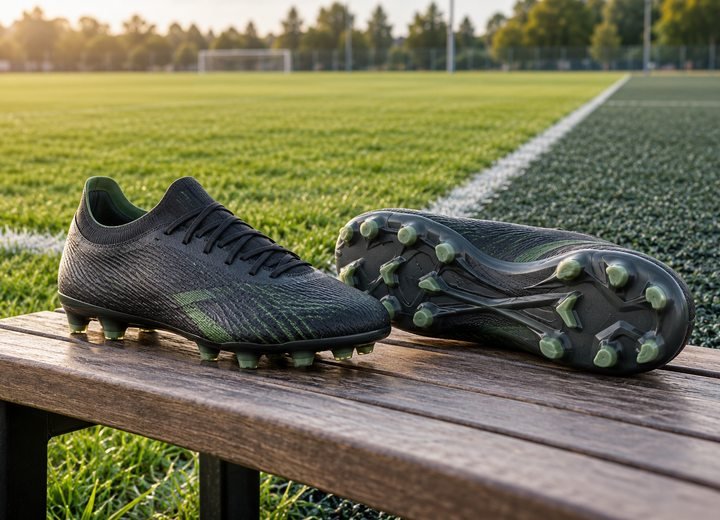
The letters describe the outsole's intended range, not the upper's fit, the stud material, a universal safety certification or the ability to play indoors. Read the product page for the exact model and outsole version you own. Similar-looking upper designs may be sold with different soleplates. A product photo of the bottom can help you distinguish them, but the manufacturer's field description remains the deciding information.
MG beside the other surface labels

| Label | Usual meaning | Check before use |
|---|---|---|
| MG | Multi Ground, a maker-defined mix of outdoor surfaces | Which natural and artificial pitches this exact model permits |
| FG | Firm Ground, generally firm natural grass | Whether the maker also names any artificial grass |
| AG | Artificial Grass, for a stated artificial pitch type | Pitch construction and product restrictions |
| TF | Turf, usually a dense small-rubber-stud outsole | Whether your short synthetic surface requires turf shoes |
| IN/IC | Indoor or court, typically a flat non-marking sole | Facility floor and non-marking rule |
These are typical category meanings, not interchangeable standards across brands. Our FG versus AG comparison examines those two labels in more detail. If your venue calls its field “turf,” ask whether it means a long-pile artificial-grass pitch or a short carpet-like surface; the word alone is not specific enough.
Use a field, shoe and venue check
- Identify the actual ground. Is it firm natural grass, a longer-pile artificial-grass pitch, short synthetic carpet, a smooth indoor court or soft wet natural grass? If the surface is unclear, ask the facility what footwear it allows.
- Check the precise product. Find the model name and outsole suffix, read its official surface guidance, and compare the actual stud layout with the listing. Do not rely on a generic search result for the brand.
- Apply the venue rule. A facility may limit certain studs even if a seller lists a broad surface category. Follow the more restrictive applicable rule. When uncertain, use a shoe explicitly named for that field.
For example, a player who uses firm grass on Saturday and an outdoor artificial-grass pitch on Tuesday might consider MG if the exact model names both surfaces and the Tuesday venue permits it. That is a conditional buying example, not a claim that any MG pair will suit both fields. If the Tuesday pitch is short carpet or the match is indoors, check TF or indoor footwear separately. Our artificial-turf cleat guide explains why pitch construction matters.
Why one MG pair may still be a compromise
A category covering multiple surfaces can be convenient if you regularly play on both. It does not replace the need for suitable traction, comfort and venue compliance on either surface. Surface conditions also change: firm grass can become soft after rain, while an artificial pitch may have a shorter pile or different infill than the one a product description assumes. Check the actual field rather than treating “MG” as an all-weather label.
If you play mainly on one surface, compare a shoe designed specifically for that surface as well. If you play on two fields, weigh convenience against how often you use each and the maker's stated limits. We cannot infer a product's grip, wear rate or injury risk from the two letters alone; those require model-specific evidence that a generic definition article does not provide.
Before you buy or pack for a match
Save the exact model page or product label, and confirm that the pictured soleplate matches the one being sold. Ask the venue about stud restrictions, especially when its booking page uses only “turf.” Check size and fit separately from the surface decision. If the product page makes no clear field claim, request clarification from the maker or seller before use rather than guessing from stud appearance.
One pair may be purchased through bootswave by inquiry or WhatsApp. Send the field types you play on, a photo or name of the model you want and your size. We can confirm the available outsole and price for the specific pair; a broad MG label is not a substitute for that confirmation.
Common questions
Are MG cleats the same as AG cleats?
No. MG is marketed for a stated mix of surfaces; AG is an artificial-grass category. Exact permitted pitches vary by maker and model.
Can MG cleats be used on indoor courts?
Do not assume so. Smooth indoor courts commonly require a court shoe and may prohibit studs. Check the model guidance and facility rule.
Can I use MG on wet soft grass?
Only if the exact model's guidance and the conditions support it. “Multi Ground” does not automatically include soft, muddy natural grass.
Sources and limits
adidas describes its own categories. Other makers and facilities may use different labels or restrictions; no model is field-tested here.
Ask about an exact outsole
Individual orders are welcome. Tell us your playing surfaces, preferred model and size; we can discuss available versions and a price for one pair. Message bootswave on WhatsApp.
Published: · Updated:
