TURF SHOES AND FIT
Turf Soccer Shoes for Wide Feet: Fit the Forefoot Without Heel Slip
For wide feet, choose a turf shoe that gives your forefoot room while still holding the heel when you cut. Going up a length merely to escape side pressure often creates heel slip. Confirm that the short-lug TF outsole suits your actual field, then compare two shapes in your playing socks.
By bootswave Editorial ·

Start with the surface, then solve the fit
A shoe that feels spacious but has the wrong outsole is still the wrong choice. Turf, often labeled TF, typically means a rubber bottom with many small, low lugs for short artificial turf. An indoor hard-court shoe has a much flatter rubber sole, while an AG cleat uses a different studded plate intended for certain artificial-grass fields. Nike separates its soccer shoes by playing surface; that distinction is more useful than the word “indoor” on a marketplace listing. Ask your facility what it permits, particularly if the field is unusually long, hard or worn.
Look underneath the exact pair in the listing. Count and inspect the small rubber contact points instead of trusting a category tag. A photo of the upper alone cannot establish that the shoe is turf-ready. If you play on both hard court and short turf, check each venue's rules; a turf shoe is not automatically accepted indoors. Our indoor-versus-turf guide explains the outsole difference in more detail.
Once you know the correct category, the wide-foot problem becomes specific: is the forefoot too narrow, is the upper too shallow over the instep, or is the whole shoe simply too short? The fix differs for each. A larger number on the box does not tell you which dimension changed enough.
Identify where the pressure actually is
Put on the socks you wear for matches, lace the shoe normally and stand with weight on both feet. Then mark the location of discomfort. Pressure at the first or fifth metatarsal head—the broad part of the foot behind the toes—points toward a shape or width issue. Pressure over the laces may mean inadequate instep volume or a lacing problem. Toes contacting the front when standing suggest insufficient length. A heel that lifts on a side step may mean too much rearfoot volume, a loose fit or ineffective lacing.
| What you notice | Check first | Better next comparison |
|---|---|---|
| Both sides press at the ball of the foot | Upper shape at the widest point | Same length in a wider last or width option |
| Top of foot feels compressed | Instep depth and laces | More volume or a different lacing arrangement |
| Toes hit the front | Foot length while standing | Next length in the same model |
| Heel lifts during a turn | Heel cup and excess length | A different shape, not simply a tighter forefoot |
A shoe may have a wide toe shape and still be low across the instep, or feel broad at the midfoot while narrowing sharply near the big toe. That is why “wide” in a review cannot replace your own fit test. Some brands sell soccer models with explicit width options; New Balance lists wide fits in its soccer range. Verify the width option on the exact turf model and in your size rather than assuming every shoe in that range comes in wide.
Measure for comparison, not for a universal “wide” label
Measure both feet near the end of the day or after normal activity, when they may be closer to match-time size. Stand with weight evenly distributed. Record the longest toe-to-heel length and the widest forefoot on each foot, and fit the larger foot. If you use a printable sizing sheet, verify its scale with a ruler before relying on it. Measurements help you shortlist sizes; the shoe's internal shape and upper still decide the result.
Check the model-specific size guide and return policy. Your normal running-shoe number is a starting point, not a guaranteed turf-shoe size. Compare the length and width of the pair you already wear comfortably, if you have one, with the candidate. Do not assume that “leather stretches” will solve meaningful pressure: material behavior differs by construction and repeated pain is a reason to reject a pair now. Nike's fit guidance emphasizes a secure fit without painful pressure; use that principle while checking the exact TF model.
If you wear orthotics or replacement insoles, bring them to the try-on. A thicker footbed reduces interior volume and can create pressure over the top even when width is sufficient. If the model has a removable insert, compare with your insert in place. Never remove a required insole permanently just to create room without checking the manufacturer's design and your clinician's instructions.
Use a short movement test before committing
- Stand and walk: Check toe contact, forefoot pressure and any folding under the ball of the foot. A snug upper is acceptable only if it is comfortable.
- Jog and stop: Your toes should not be driven hard into the front, and the shoe should not feel as though it rolls beneath the foot.
- Side-step both ways: Watch for heel lift and the foot sliding across the footbed. TF play involves frequent lateral cuts, so straight-line comfort is incomplete evidence.
- Repeat with the other foot: Feet often differ. Do not judge both shoes from a test on the smaller foot alone.
- Keep them on briefly: Localized numbness or increasing pressure after several minutes is a reason to try another shape.
Do this on a clean indoor surface if you may return the shoes; a retailer may reject a pair used on a pitch. The test is a practical screening step, not a guarantee about injury prevention or long-term comfort. If you have recurring pain, numbness or a foot condition, seek advice from an appropriate health professional rather than trying to force a narrow shoe to work.
If one size has the right forefoot but loose heel, a different last is often a better path than extreme tightening. Pulling laces hard can replace side pressure with top-of-foot pressure. Try a different model, and compare its rearfoot hold. Similarly, if the heel feels secure but the outside of the forefoot bulges over the sole edge, do not assume the material will safely mold around it.
What photos and product descriptions can prove
An online listing can verify the outsole pattern, size range, material and whether an explicit width is offered. It usually cannot verify the interior width at the exact point your foot needs room, how the heel holds during a cut, or whether a stated “wide fit” refers to the forefoot or overall volume. Ask for a top-down photo, outsole photo, model code and width designation. A photo of the shoe on a last can help compare shape, but angle and lens distortion limit precision.
Read reviews for repeated descriptions of pressure location, not just a five-star average. A reviewer who wears thick socks or sizes up may experience a different fit. When possible, compare two candidate pairs at the same time and keep notes on the exact sizes; that isolates the difference more clearly than trying one pair weeks apart. If you are buying one pair through bootswave, send your foot length, usual size, playing surface and the model you are viewing. We can discuss available options and price, but final fit remains something you should assess on your feet.
Common questions
Should wide feet always go half a size up in turf shoes?
No. Extra length can cause sliding and heel lift without fixing a narrow forefoot. First compare a wider shape or an offered width in your measured length.
Are turf shoes the same as indoor soccer shoes?
Not usually. TF turf soles have many short lugs; hard-court indoor soles are much flatter. Follow your venue's rule and the exact model's surface guidance.
Can I break in a painful turf shoe?
Minor changes in feel may occur, but persistent numbness, sharp pressure or overhang at the sole edge is a poor starting point. Try another shape rather than relying on break-in.
The practical decision
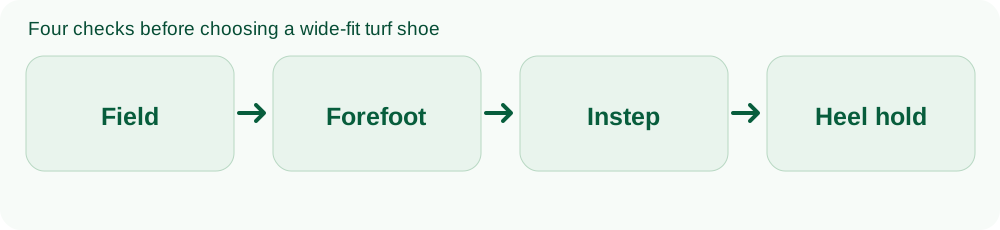
Buy the pair that is appropriate for your field, lets your forefoot spread without localized pressure, and holds your heel through a side step. Keep length, width and instep as separate questions. If no candidate passes all three fit checks, keep searching; a larger size with the same narrow shape is rarely a reliable shortcut.
Sources and scope
- Nike soccer shoe surface guide
- New Balance soccer shoe categories and width options
- Nike football boot fit guide
This guide combines published manufacturer guidance and editorial decision steps. It is not a hands-on test of a particular bootswave product. Product instructions and venue rules for your exact model take priority.
Ask about a product
You can ask about one pair or one jersey. Tell us the style, size, delivery country and your question; we can confirm options and price. Message bootswave on WhatsApp or use this form.
Published: · Updated:
