KIDS’ FOOTWEAR
Kids’ Turf Soccer Shoes: Match the Sole to the Field
Kids’ turf soccer shoes usually have many small rubber lugs for short, firm synthetic turf. Before buying, ask the coach what the field surface is and what footwear it permits. A longer artificial-grass field, natural grass pitch and hard indoor court can call for different soles, even when they are all called “soccer fields.”
By bootswave Editorial ·

Find out which kind of artificial surface the child uses
Ask for the field name, a photo and the footwear rule. “Turf” can describe short, firm synthetic carpet, while a modern artificial-grass pitch may have longer blades and infill. The two surfaces can feel and behave differently. A field may be inside a building yet still use turf, so “indoor soccer” on a calendar does not settle the sole choice. Likewise, a school’s outdoor synthetic practice area is not automatically identical to a full-size artificial-grass pitch.
adidas distinguishes kids’ turf, artificial-ground, grass and flat indoor soles. Its description puts rubber-studded turf shoes on short-bladed turf and AG cleats on longer artificial grass. Skechers’ surface guide also separates TF from hard-court and field-stud designs. These are useful starting categories, but the maker’s rating for the exact shoe and the venue’s rule still matter.
If you cannot identify the field, do not guess from a listing photo of green grass. Ask the coach whether shoes with raised studs are allowed, whether turf lugs are preferred and whether a nonmarking sole is required. That answer can save a wasted purchase. A single pair may serve several similar short-turf sessions; it does not automatically cover every other surface in the schedule.
Recognize a turf outsole at a glance
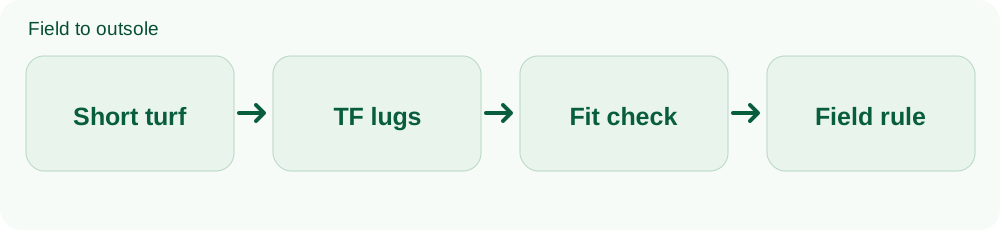
Turn the shoe over. A typical TF or turf outsole has many short, closely spaced rubber lugs across much of its underside. A grass or AG cleat has fewer, more distinct studs; a hard-court indoor shoe is comparatively flat, with rubber tread rather than projecting lugs. Product photos of the upper alone are not enough. Request a clear underside photo of the exact size or model if the store omits one.
adidas describes its kids’ turf outsoles as having many small rubber lugs. That description supports the visual check, but it is not a promise that every shoe marketed as “turf” has the same lug height or performs equally on every carpet. Consider the age and condition of the field. A very worn, hard surface can call for a different feel from a newly installed surface, and the venue may have its own limits.
| Playing surface | First sole to examine | Question to ask |
|---|---|---|
| Short, firm synthetic turf | TF with many short rubber lugs | Does the venue allow this outsole? |
| Longer artificial grass | Manufacturer-rated AG design | Is the model rated for this pitch? |
| Hard gym or futsal court | Flat indoor/court rubber sole | Must it be nonmarking? |
| Natural grass | Surface-rated grass cleat | What are the ground conditions? |
The table is a decision aid, not a universal safety certification. Check the actual shoe, field and competition rule before play.
Do not use a convenient sole on the wrong surface
A child may already own a pair of FG cleats for weekend grass matches. That does not mean the same pair is the best choice on short carpet turf. Long, firm studs can feel awkward on a hard synthetic surface and may violate the facility’s policy. At the other extreme, a flat hard-court shoe may offer a different grip pattern from a turf shoe on outdoor carpet. If the coach allows several options, compare them on the specific field rather than assuming the names are interchangeable.
AG cleats are another category. They are designed for artificial grass, but the exact stud configuration and rated surfaces differ among models. Do not infer that “AG” always means “any turf” or that a TF shoe is ideal on every full-size synthetic pitch. Our turf versus cleats comparison gives the broader outsole distinction; this article is for the parent buying a youth TF pair for short turf.
Where the schedule genuinely alternates between a gym and short turf, ask if a second pair is necessary. The kids’ indoor shoe guide covers hard-court fit and the “indoor” naming confusion. One pair may be convenient, but compliance and fit are more important than avoiding a second purchase.
Check fit on a growing foot
Have the child try both shoes with the socks worn for games. The longer foot should have enough toe space for a natural stance, the forefoot should not be squeezed, and the heel should stay in place when the child takes a few controlled steps. A normal school-shoe size is a starting point, not a guarantee. The Australian Podiatry Association advises measuring both length and width and allowing toes to move freely in children’s shoes; apply that basic fit check here while respecting the closer feel of sport footwear.
Buying a full size too large to extend its life can allow the foot to move on a stop. A shoe that pinches at the sides should not be treated as acceptable because the child may “break it in.” Ask the child to point to pressure zones. If the heel slips but the forefoot is tight, a different shape may be needed rather than tighter laces. Our wide-foot youth guide explains that mismatch.
For a younger player, consider whether they can fasten the shoe themselves. Laces allow adjustment across the foot; straps can simplify changing but still need secure hold. Check the closure after a few steps. A dangling lace or loose strap is a practical problem at training, regardless of the outsole design.
Check wear and care after training
Short rubber lugs can collect grit, small stones or turf infill. Brush the sole after use and let the shoes dry before sealing them in a bag. Inspect lug wear at the heel and forefoot: if a once-clear pattern has become very smooth, compare grip and discuss replacement before the next slippery session. Do not judge traction solely from a product’s age; cleaning and field moisture also change how it feels.
Keep the pair out of direct heat when drying. Check the maker’s care instructions, especially if the upper has bonded layers or decoration. For a child who trains several times a week, reassess both sole wear and foot size regularly. A shoe can still look good from above after the child has outgrown it or the lugs have worn down.
Bootswave can help with an individual youth pair or a team order by inquiry. Send a photo of the field, the model or outsole that interests you, the child’s current size and the delivery country through our contact page or WhatsApp. We can confirm options, availability and price; the pictured shoe is an outsole illustration, not proof that it comes in every children’s size.
Common questions
Are kids’ turf shoes the same as indoor soccer shoes?
No. Turf shoes have short rubber lugs; hard-court indoor shoes usually have a flatter rubber sole. Identify the playing floor before choosing.
Can my child wear turf shoes on artificial grass?
It depends on the pitch, the exact model and the venue. Short turf and longer artificial grass are different categories; ask the coach and check the manufacturer’s surface rating.
Should I choose shoes by age?
No. Use age only as context. Measure the child’s feet and compare the specific shoe’s size chart and fit.
The practical answer
Get the field and footwear rule first. For short synthetic turf, inspect a TF outsole with many small rubber lugs, then fit the child in playing socks and check heel hold. If the surface is longer artificial grass or a hard court, start the sole decision again rather than assuming “turf” covers it.
Sources and scope
- adidas: soccer shoes for kids and surface types
- adidas: kids’ turf soccer shoes
- Skechers: soccer cleat surface guide
- Australian Podiatry Association: school shoe fit
This guide combines published manufacturer guidance and editorial decision steps. It is not a hands-on test of a particular bootswave product. Product instructions and venue rules for your exact model take priority.
Ask about a product
You can ask about one pair or one jersey. Tell us the style, size, delivery country and your question; we can confirm options and price. Message bootswave on WhatsApp or use this form.
Published: · Updated:
