KIDS’ FOOTWEAR
Kids’ Indoor Soccer Shoes: Court, Turf, and Fit
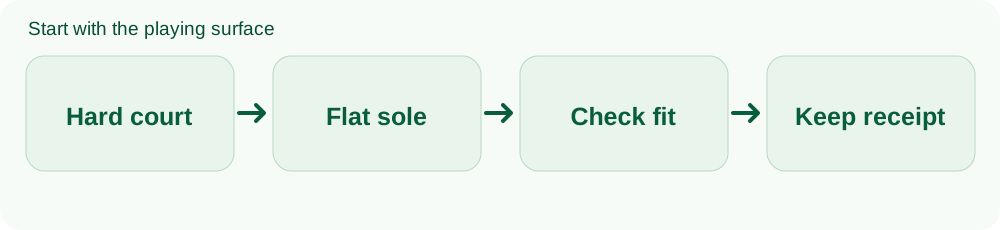
For a hard indoor court, start with a flat, usually nonmarking rubber sole; for an indoor turf field, check whether the venue permits turf shoes instead. Then fit the child’s larger foot in playing socks and test stopping, turning, and heel hold. “Indoor” on a schedule does not tell you which floor the child will use.
By bootswave Editorial ·

Find out what “indoor” means at this venue
Ask the coach or facility for the playing surface and footwear rule before choosing a pair. A polished gym or futsal court calls for a flat rubber outsole. A synthetic turf field under a roof is still turf; depending on its carpet and rules, a short-nub turf shoe may be the suitable option. Long field studs are not a substitute for either one. The word “indoor” describes the building, not the surface under a child’s feet.
Under Armour’s youth cleat guide distinguishes flat-soled indoor shoes from field cleats. Skechers’ surface guide separates turf from indoor court outsoles. Those are category descriptions, not permission to wear any particular model at every venue. If the team alternates between a court and artificial turf, ask whether the child needs two pairs. A shoe that performs tolerably on one surface may be poor or prohibited on the other.
| Where the child plays | First sole to inspect | What to verify |
|---|---|---|
| Wood or hard indoor court | Flat rubber indoor/court sole | Nonmarking requirement and clean, grippy tread |
| Short synthetic turf indoors | Short-nub turf sole | Facility permission and turf pile |
| Outdoor natural grass | Surface-rated grass cleat | Ground condition and manufacturer rating |
Inspect the outsole, not just the product name
Turn the shoe over. A hard-court indoor sole is comparatively flat, with rubber tread covering a broad contact area. A turf outsole has many small raised grip points. A grass cleat has distinct studs. A listing may use “indoor,” “turf,” and “soccer” loosely, especially in a mixed-category store, so the outsole photograph and the manufacturer’s stated surface matter more than the headline.
For a gym floor, ask whether “nonmarking” is required. That term concerns marks left on the floor, not a guarantee of traction on every dirty or damp surface. If no outsole photo is available, ask the seller for one before ordering. A shoe with a flat-looking side profile can still have raised turf nubs underneath. Conversely, a flat sole does not make an ordinary running shoe equivalent to a soccer court shoe: its cushioning and upper may feel different during ball control and lateral movement.
Our indoor versus turf comparison shows the sole distinction in more detail. This page focuses on the parent’s sequence: identify the floor, check the rule, then fit the child. There is no universal “one shoe for every indoor league” recommendation.
Fit the child’s feet as they are today
Have the child wear the socks used for practice and stand with weight on both feet. Check the longer foot first, then the other. Toes should lie naturally rather than curl into the front. The forefoot should not be squeezed at the widest point. The heel should stay seated while the child walks, jogs, stops, and makes a controlled side step. A secure shoe can still allow the toes to move; “secure” does not mean painful.
Do not decide from age or a familiar school-shoe size alone. Children’s feet grow at different rates, and brand sizing can differ. The Australian Podiatry Association’s parent guide stresses matching the shoe to the activity and checking fit. Treat a size chart as a starting point, then verify the exact model. If one foot is larger, the larger foot should not be cramped merely to make the other feel snug.
Buying several sizes too large for future growth can let the foot slide when the child brakes. Tightening the laces may hide that problem for a few steps but does not change excess length. At the opposite extreme, a shoe that causes numbness or obvious red pressure marks during a short try-on is not a good break-in candidate. Try another shape or model. For a broader four-zone check, use our soccer shoe fit guide.
Choose a closure the child can actually use
Traditional laces allow the adult and child to adjust pressure across the forefoot and midfoot. Hook-and-loop straps may make changing faster for a younger player, but they must still hold the heel and midfoot through movement. A laceless design has fewer adjustment points, so an initially loose or pinching fit is harder to correct. The closure choice is practical, not a performance ranking. Under Armour’s youth guide presents laces and hook-and-loop as options based partly on preference and ease of use.
Ask the child to put on and remove the shoes without rushing. If the session starts with a crowded changing area, a closure they can manage independently can matter more than a decorative feature. Check that laces do not drag and that straps stay fastened after several stops. If they need help tying, teach a secure double knot or choose a manageable closure; do not leave a loose lace to trail during play.
Run a short movement and ball test
On a permitted clean surface, have the child walk, accelerate gently, stop, side-step, and tap a ball. Watch whether the heel lifts or the foot twists inside the shoe. Ask what they feel at the toes and sides, rather than assuming their silence means comfort. A child may say a new shoe feels “tight” when the real issue is stiff unfamiliar material, or may call sliding “roomy.” The observable movement helps separate those descriptions.
Do not conduct a risky sprint or sharp cut in a store aisle. If a home try-on is allowed under the return policy, use a clean indoor floor without soiling the outsole or removing tags. The ultimate court grip also depends on floor cleanliness, moisture and tread condition; a brief try-on cannot prove how a shoe will perform over a season. After purchase, check tread wear and sizing periodically, especially if the child suddenly complains of toe pressure or starts avoiding the shoes.
Buying online: send the right questions
Before paying, ask for the exact outsole photograph, labeled playing surface, size chart for that model, interior length if supplied, width or fit description, and return terms after an indoor try-on. For a parent buying one pair, there is no need to provide a team order or design brief. The relevant facts are the child’s current foot measurements, intended court or turf field, sock thickness, and destination country.
Bootswave sells to individual players as well as teams by inquiry. If a model in our soccer shoe collection interests you, send the size and a photo or link to the model through our contact page or WhatsApp; ask us to confirm its outsole, availability, price and delivery options. Do not assume every displayed soccer shoe is suitable for an indoor court. A coach’s venue rule and the exact outsole still decide.
Common questions
Are indoor soccer shoes the same as turf shoes?
No. A hard-court indoor shoe usually has a flat rubber sole; a turf shoe has short raised grip points. Ask which surface and outsole the facility permits.
Can my child wear running shoes for indoor soccer?
Check the venue rule first. Running shoes may be permitted for a casual session, but their fit and sole are not designed to feel like dedicated court soccer shoes during repeated ball contact and lateral movement.
Should I size up for growth?
Allow reasonable room for natural toe position, but avoid so much extra length that the foot slides when stopping. Check the exact model and return policy.
The practical answer
Get the floor and footwear rule from the venue, inspect the sole, then fit both of the child’s feet in playing socks. On a hard court, start with an indoor court shoe; on indoor turf, verify the field and allowed turf sole. Buy the pair that stays secure during a gentle movement test, not the one with the most appealing label.
Sources and scope
- Under Armour: How to buy soccer cleats for kids
- Skechers: soccer cleat surface guide
- Australian Podiatry Association: choosing a child’s shoe
This guide combines published manufacturer guidance and editorial decision steps. It is not a hands-on test of a particular bootswave product. Product instructions and venue rules for your exact model take priority.
Ask about a product
You can ask about one pair or one jersey. Tell us the style, size, delivery country and your question; we can confirm options and price. Message bootswave on WhatsApp or use this form.
Published: · Updated:
