INDOOR FOOTWEAR CHECK
Can You Wear Running Shoes for Indoor Soccer?
Sometimes a clean running shoe is permitted on an indoor court, but permission and suitability are different questions. Check the venue's footwear rule first, then inspect the sole, lateral stability and fit. A flat indoor soccer shoe is usually the more purpose-built choice for regular hard-court play.
By bootswave Editorial ·
Quick Reference
- Ask the facility what outsole it allows
- Look for a clean, non-marking rubber sole
- Running cushioning does not prove side-to-side stability
- Do not use outdoor studs on a hard court
- Try controlled stops and turns before playing
- Stop if the shoe slips or your foot rolls inside it
Overview
The Short Answer: Allowed Does Not Mean Ideal

There is no universal yes or no for every indoor soccer venue. Some recreational programs allow clean athletic shoes with non-marking rubber soles. A futsal competition, school gym or private facility may set a more specific footwear rule. Read that rule or ask the organizer before arriving.
Even when a running shoe is allowed, it was designed mainly around repeated forward strides. Indoor soccer asks you to brake, turn and move sideways. A soft, tall heel or a loose upper may feel different under those loads. That does not mean every running shoe is unsafe; it means you should not use the words “sneaker” and “indoor soccer shoe” as if they guarantee the same behavior.
The FA's futsal equipment law specifies training or gymnastic shoes with rubber or similar soles. Your actual competition and facility instructions still control what is accepted locally. If you only need to know whether turf shoes are appropriate, use our separate indoor-versus-turf guide.
02 / Sole check
Compare the Soles Before the Brand Labels

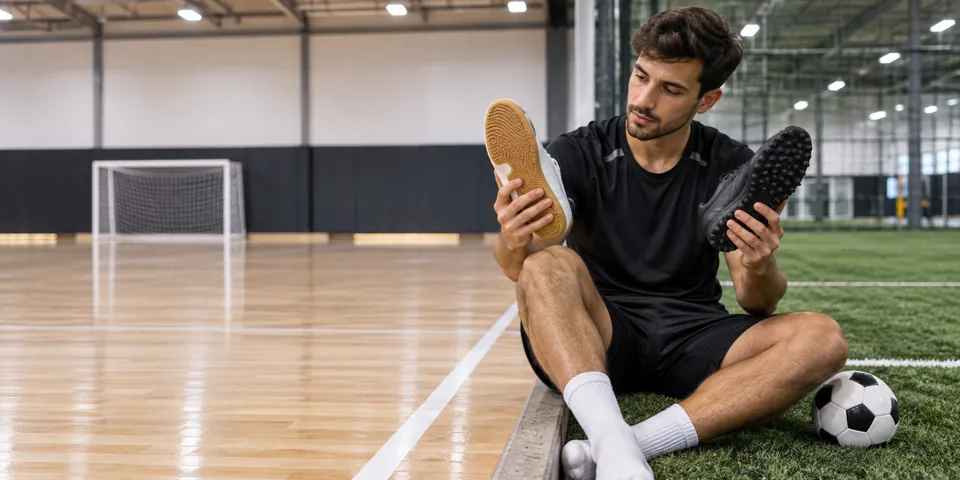
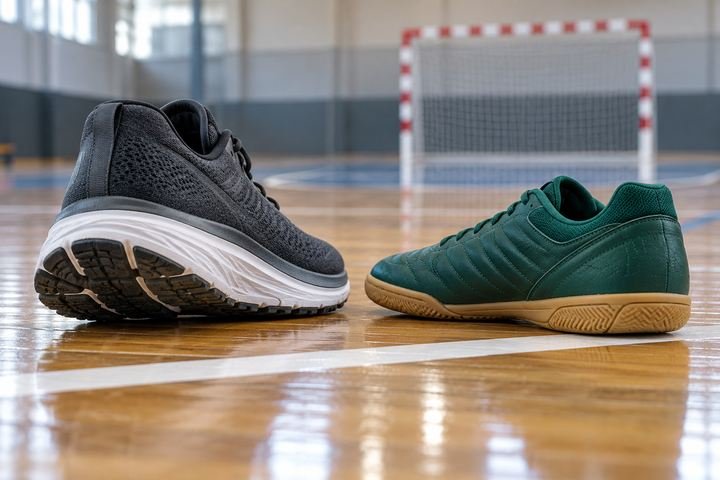
Turn both shoes over. The court is a smooth, hard surface, so the contact pattern matters more than a product name alone. Indoor soccer shoes commonly have relatively flat rubber outsoles made for court contact. Running-shoe tread and rubber vary widely; some may mark floors, carry dirt in the grooves or feel unpredictable on a polished surface.
| Check | Running shoe | Indoor soccer shoe |
|---|---|---|
| Outsole | Varies by road or trail design; check cleanliness and marking | Typically flatter court-oriented rubber; verify the product and venue rule |
| Midsole | Often more cushioning and heel height | Often lower-profile for court feel, though models vary |
| Lateral movement | Upper hold varies; forward-running comfort is not enough evidence | Designed with soccer cuts in mind, but fit still matters |
| Ball contact | May have bulky overlays or a high toe shape | Usually built for close control and kicking |
A “non-marking” label helps answer a floor-protection question; it does not prove the shoe has adequate grip or hold for you. Conversely, a dark rubber sole is not automatically marking. The facility can tell you what it accepts.
03 / Movement test
A Four-Step Check Before You Join the Game

If the organizer permits your shoes, test them before a full-speed game. Keep the test modest and stop if anything feels unstable.
- Inspect and clean the soles. Remove grit or stones that could scratch the court. Check for detached rubber, worn patches and uneven wear.
- Check the fit in your playing socks. Tie the shoes firmly without pain. Your heel should stay seated; your toes should not collide with the front when you stop.
- Walk, stop and turn slowly. Watch for unexpected sliding, outsole grabbing, or the foot moving across the footbed while the shoe stays planted.
- Increase only if it feels controlled. A few light changes of direction are enough for a first check. Pain, ankle rolling, numbness or repeated sliding are reasons to stop and change footwear.
Do not treat a successful hallway walk as a match test. A surface may also change with dust or moisture during a session. Recheck grip if conditions change. The FA venue footwear guide distinguishes flat indoor soles from other surface types; your own venue may apply different categories.
04 / Practical alternatives
If You Only Have Running Shoes Today

Contact the facility before leaving home. Describe the sole, not just the shoe's marketing name, and ask whether clean running shoes are permitted. If they are, bring them clean and run the movement check. If the facility says no, do not assume a different pair of outdoor cleats will solve the problem.
Ask whether loaner shoes are available or whether another clean gym shoe you own is accepted. For a regular league or repeated hard-court sessions, compare a purpose-built indoor soccer pair. Select size and fit as carefully as surface type; a court shoe that crushes your toes is not an improvement simply because it has the right sole.
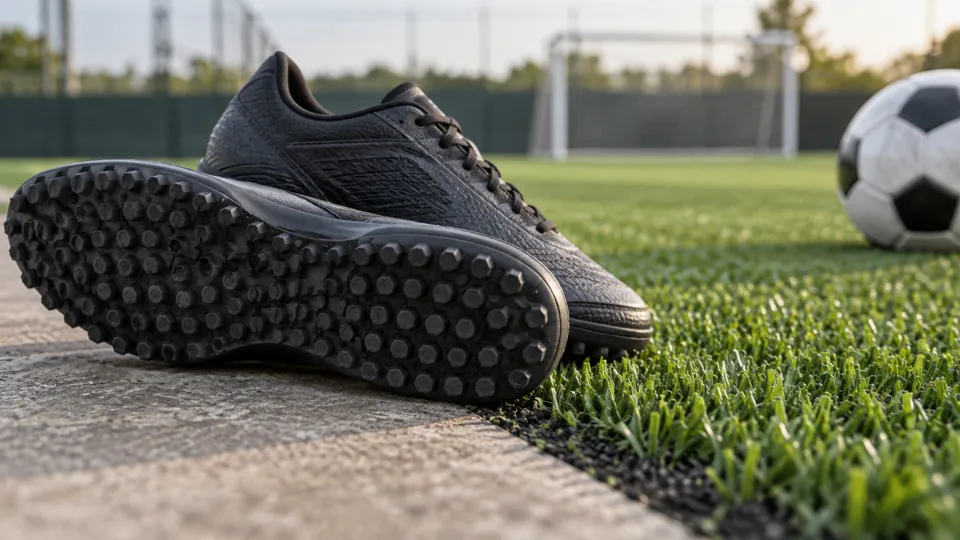
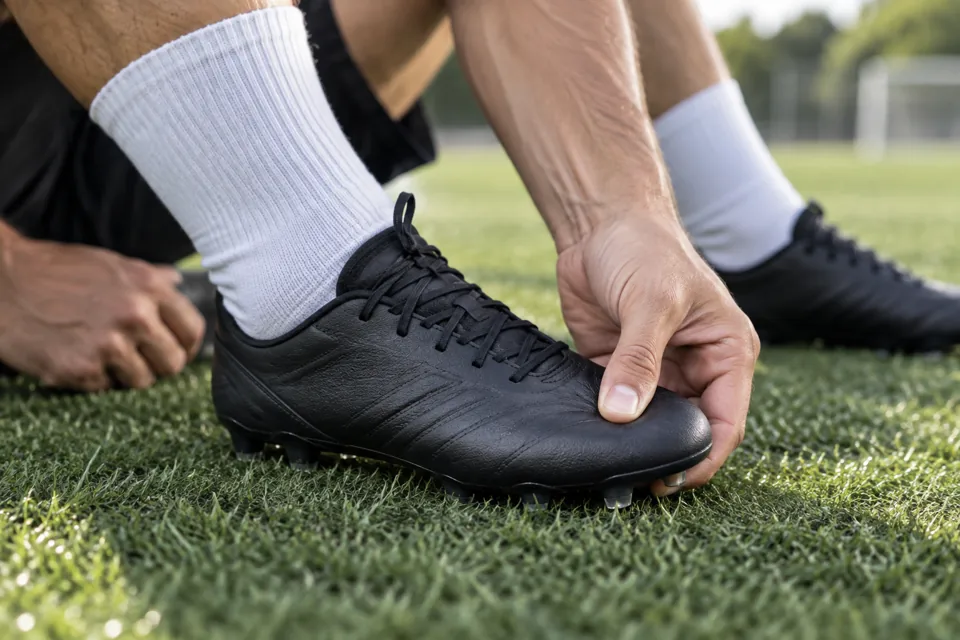
Do not wear grass cleats with protruding studs on a polished indoor court. They can damage the floor and are commonly prohibited. Turf nubs are a separate design and should be checked against that venue's rules rather than assumed acceptable.
05 / For your situation
How the Answer Changes for Kids and Casual Players

For a one-off casual session, an approved, clean and well-fitting gym or running shoe may be a workable option. For weekly futsal, the repeated cuts and ball work make a court-oriented shoe a more relevant comparison. The decision rests on the actual pair, floor and player—not a fixed rule that one category always prevents injury.
For children, check that the child can stop and turn without the heel lifting or the foot sliding inside the shoe. Oversizing “for growth” makes this harder to judge. Ask the coach whether the program uses a hard court or indoor turf; those surfaces can require different soles.
If you need an indoor pair, browse soccer footwear and ask bootswave about a current indoor option, fit and price. Individuals can inquire about one pair through the site or WhatsApp. We can discuss a team order too, but you do not need a team to ask.
GAME-DAY DECISION
A practical rule for the pair you already own
If this is a one-off casual session, first ask the organizer whether the shoes are allowed on that floor. Look underneath: the sole should be clean, intact and acceptable for the court. Then do a short controlled test in the space: walk, jog, stop and move sideways. If the shoe slides, catches abruptly or lets your foot roll inside it, change footwear or skip play. Permission alone does not show that the pair will feel stable for your movements.
For repeated indoor soccer, compare an indoor model in the same socks. Examine the flat contact pattern and heel/midfoot hold rather than assuming every shoe labeled “training” fits the venue. On artificial turf, the correct starting category may be a turf shoe instead of an indoor-court shoe. Nike's surface guide separates these outsole uses; the venue's rule and the actual floor remain essential checks.
FAQ
Frequently Asked Questions

Can I play futsal in my running shoes?
Only if your competition and venue allow that pair. Check the outsole and try controlled stops and turns; a permitted running shoe may still feel less stable than a suitable indoor soccer shoe.
Does non-marking mean a running shoe is good for indoor soccer?
No. It addresses possible floor marks. You must also assess grip, fit and how securely the shoe holds your foot during side-to-side movement.
Can I wear outdoor soccer cleats on an indoor court?
Do not assume so. Protruding grass studs are generally unsuitable for a polished hard court and may be prohibited; follow the facility's footwear policy.
Are turf shoes the same as indoor soccer shoes?
No. Turf shoes use small lugs for turf; indoor court shoes generally use a flatter rubber sole. Check the actual playing surface and facility rules.
What if my running shoes slip during warm-up?
Stop the test. Check for dust or moisture and change to approved footwear with dependable grip; do not play at speed while repeatedly slipping.
Summary
Check Permission, Then Check Movement

A running shoe can sometimes be allowed for indoor soccer, but its label is not enough. Confirm the venue rule, inspect the sole and test fit and grip at low speed. Choose a court-oriented shoe when your current pair slides, shifts on your foot or fails the venue's policy.
Sources and Further Reading
Venue policies and shoe constructions vary. Confirm the rule for the court you will actually use.
Product question
Ask About Soccer Gear

Tell us whether you play on a polished indoor court or indoor turf, plus your shoe size and fit concern. Ask about an available pair and its current price using the form or WhatsApp; a single-pair question is welcome. Open WhatsApp.
Keep reading