TEAM JERSEY GUIDE
Soccer Jersey Number Size: How Big Should It Be?
For a recreational shirt with no stated rule, an 8-inch (about 20 cm) back number is a decorator starting point, but it must fit the actual shirt. Formal competition rules may require more: UEFA currently specifies 25–35 cm for men and 20–35 cm for women in its competitions. Check your organizer’s rules, measure the back panel and approve a full-size sample before a team run.
By bootswave Editorial ·
Competition rules come before a generic number chart
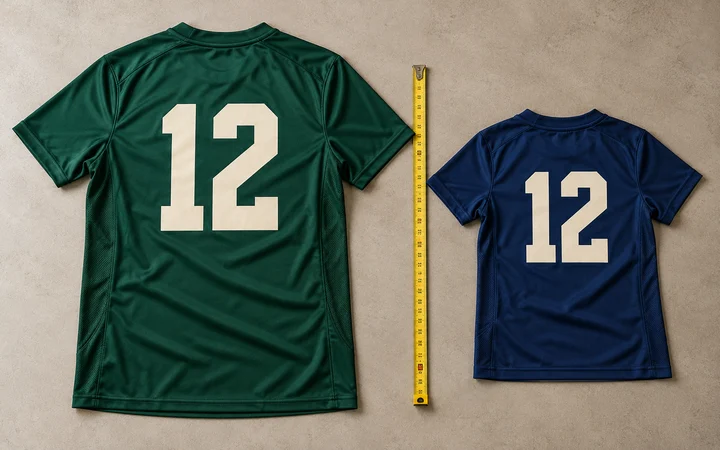
A back number's size is partly a design decision, but in organized play it can also be a rule. Some competitions specify the height, contrast, location, or permitted range of numbers. Ask your league or tournament for its current uniform regulations before sending artwork to print. IFAB Law 4 lists basic player equipment, but gives no universal back-number height for youth or recreational teams. Treat your competition's kit rules as the controlling document.
For a concrete example, UEFA Equipment Regulations Article 10 requires back digits 25–35 cm high on men's shirts and 20–35 cm on women's shirts, with 2–5 cm stroke widths, in competitions within its scope. That is a real rule, not a universal recommendation for a child or a local U.S. league. Your own organizer's document is the primary authority. If it says nothing about physical dimensions, choose a legible proportion based on the real garment and ask the kit coordinator to approve it.
Do not confuse the number itself with its physical size. Our article on what soccer jersey numbers mean explains player-number choices and traditions. This page concerns how large and where to print the digits. Two teammates can both wear number 10 while their youth and adult shirts require different artwork sizes.
Measure the available space on the exact jersey
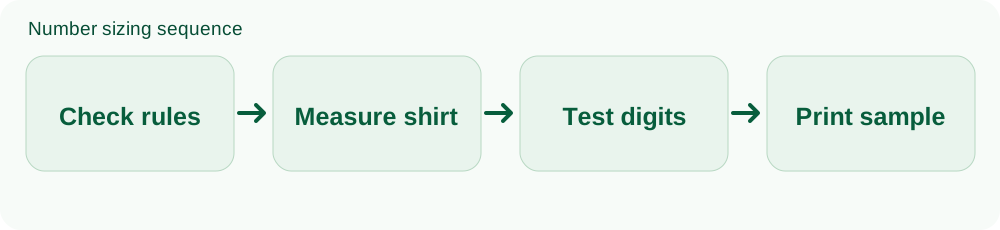
Lay the shirt flat without stretching it. Measure the back panel between the collar area and the lower hem, and note the seam positions, mesh panels, vents, yoke and any sponsor mark. Decide whether a player name will sit above the number. A youth shirt has less room than an adult shirt; even adult versions can differ greatly by cut. If the club uses both male and female fits, check each approved model rather than assuming the same printable rectangle.
Use the largest number combination you expect, often two digits, to test width and alignment. A wide pair of digits can be crowded even when a single “1” looks fine. Keep adequate space between the digits and around them so the shirt can move without the design running into side seams. Have the print provider advise where the transfer can safely sit on the fabric. A centerline on a flat mock-up can shift visually once the jersey is worn, so view a sample on a person.
Stahls' soccer placement guide lists 8-inch (about 20 cm) back numbers as a decorator starting point for both youth and adult shirts. This is not a league rule: it falls below UEFA's current men's minimum and might be too large for some small youth garments. Use it as an example of how recommendations and regulations can differ. Choose final dimensions from your competition rule and the actual garment, then test a sample. Do not simply enlarge or shrink an adult print for a child size; shoulder width and back length change.
Test readability before printing
Print a paper number at full scale or tape a temporary template to the jersey. Step back across a room or a short training field and ask someone who has not seen the design to read it. Dark digits on a dark shirt or a thin outline can fail even when the number is technically large enough. A busy back pattern may also reduce contrast. Judge both the single-digit and widest two-digit layouts.
Check the complete design rather than the number alone. A name above it, a sponsor below it, a crest near the shoulder and a hem label all compete for space. If the number becomes too small to fit everything, simplify the surrounding artwork or ask whether the organizer permits a different placement. Do not shrink a required league number to make room for an optional sponsor.
For youth teams, ask children to try on the sample. The number should sit on the back panel when the shirt moves, not fold into the hem or disappear under a waistband. Take a photo from behind while the player stands and jogs. That is a design check, not a claim about athletic performance. Keep the same viewing distance and lighting when comparing two versions so your choice is meaningful.
Print method and care matter after the size is chosen
Different decoration methods need different artwork preparation and application instructions. A heat transfer may require a certain border, material and placement area; a sublimated jersey incorporates the number into a different production process. Ask the printer for the art file format, allowed line thickness, fabric compatibility and color proof. Do not rely on a low-resolution screenshot for a team run when a clean vector or production-ready file is available.
Make one complete sample with the exact shirt, print method, color and largest number format. Inspect for edge lift, distortion across seams and unintended color change. Then wash the sample according to its own label and the decoration maker's care instructions. A print that looks good immediately after pressing may still need a real-world check before dozens of shirts are ordered. Record the approved art dimensions, file version and print position for future replacements.
Before production, create a player list with name, number and size, and have every entry verified. Duplicate numbers, misspellings and last-minute size changes are common practical risks, independent of whether the digit height is perfect. For an individual shirt, check the personalized-item return policy before printing. Our jersey size guide helps confirm the garment itself before you commit to a non-returnable number.
bootswave can discuss a single shirt or team set through our contact page or WhatsApp. Send the exact model, size range, country of delivery, your organizer's number rules and the desired artwork. We can confirm available options and price after reviewing the request; we cannot certify compliance with a league rule we have not seen.
Common questions
Is there a universal adult back-number height?
No. Competition rules and jersey dimensions vary. Start with your organizer's current requirements, then test the exact shirt.
Can youth and adult jerseys use the same print size?
Sometimes a league specifies a common minimum, but the visual fit may differ. Measure both garments and check the rule before standardizing artwork.
Should I use a separate number size for two digits?
Check the width of the widest two-digit combination. The number height may stay the same while spacing or font choice needs adjustment, subject to the competition's rules.
The practical answer
Find your league's rule, measure the shirt, test the largest digit combination at real size and viewing distance, and approve a sample. A number that is readable, compliant and placed clear of seams is more useful than a number chosen from an unrelated chart.
Sources and scope
- UEFA equipment regulations, player numbers
- IFAB Law 4, players equipment
- Stahls design and placement guide
This guide combines published manufacturer guidance and editorial decision steps. It is not a hands-on test of a particular bootswave product. Product instructions and venue rules for your exact model take priority.
Ask about a product
You can ask about one pair or one jersey. Tell us the style, size, delivery country and your question; we can confirm options and price. Message bootswave on WhatsApp or use this form.
Published: · Updated:
