CLEAT FIT GUIDE
Soccer Cleats for Narrow Feet: How to Check the Fit
For narrow feet, keep the correct length and find a closer heel and midfoot shape. A smaller size can crush your toes while leaving heel slip unsolved. Measure first, then test the exact model in playing socks with a few controlled movements.
By bootswave Editorial ·
First identify where the cleat feels loose
“Narrow foot” is a useful starting description, but it does not tell you which part of a shoe is wrong. A slim heel can slip inside a shoe with an otherwise comfortable forefoot. A low instep can leave excess material over the laces. A narrow forefoot can move sideways even while the heel stays put. Check these zones separately before trying a shorter size.
Measure both feet while standing and use the longer foot to choose an initial length from the exact brand and model chart. The Nike soccer cleat chart, for example, gives a foot-length starting point. It is still only a starting point: two boots with the same printed size can have different heel, instep and toe shapes. Our cleat size versus shoe size guide explains why an everyday sneaker number is not enough.
Nike describes its Mercurial boots as more contoured and narrow than its natural-fit lines in its football-boot fit guide. That is one maker's line-level description, not a promise about every model, release, material or player's foot. Use it to choose a shape to try, then let the fit test decide.
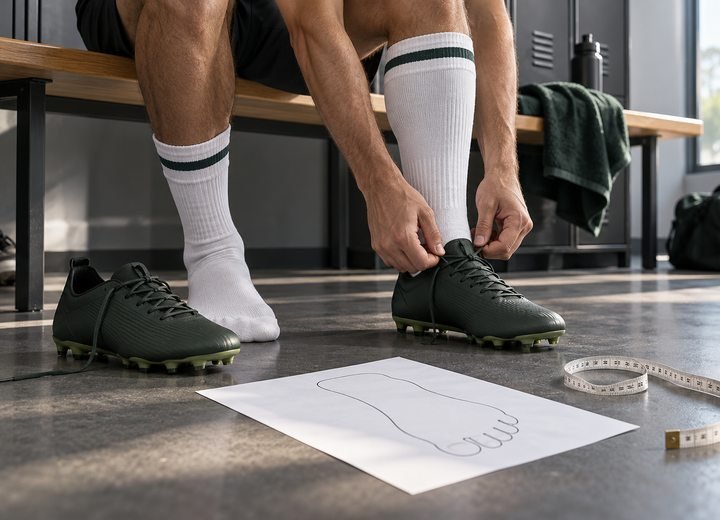
Run a five-minute fit check in match socks

- Stand naturally. Wear the socks and orthotic or insole you actually play in. Your longest toe must be able to rest naturally; it should not curl or be forced against the front.
- Lace normally. Secure the midfoot without pulling so tightly that the laces hurt the top of the foot. A large folded pocket of upper material points to too much volume.
- Walk, rise onto your toes and take controlled side steps. Notice whether the heel repeatedly lifts, whether the forefoot slides, and whether the foot rolls over the sole edge. Try both shoes; feet often differ.
- Pause and check pressure. Hard pressure at the little toe, numbness, tingling or painful toe contact means the “locked-in” feel has gone too far. Do not count on a match to make a painful shape safe.
A small amount of perceived movement is different from the foot repeatedly shifting inside the boot. You need enough hold for your own play without forcing the foot into a shape it cannot tolerate. The general soccer cleat fit guide covers the full-foot check.
Choose the next adjustment from the symptom
| What you feel | What it may mean | Next check |
|---|---|---|
| Heel rises, toes have room | Heel shape or overall volume may be too open | Compare a closer heel or a more adjustable laced model |
| Upper folds over the laces | Too much midfoot or instep volume | Try a lower-volume last; do not simply tighten harder |
| Forefoot moves sideways | Forefoot shape may be too broad | Compare the same length in another model |
| Toes curl or go numb | Length or toe shape may be too restrictive | Reject the fit and compare another size or shape |
These are diagnostic try-on cues, not measurements of a particular bootswave shoe. The key distinction is that heel hold, upper volume and front length can point to different solutions.
Why sizing down is usually the wrong shortcut
Going down a size changes length as well as internal volume. It may hide looseness for a moment while moving the longest toe closer to the end, especially when stopping or changing direction. Nike's fit discussion notes that recreational players generally do not need to size down to imitate an elite player's tight fit. Choose the length your foot can use first; then change the model if the heel or upper stays loose.
Thicker socks and alternative lacing can slightly change feel, but they cannot change the underlying last. A removable insole may affect volume, yet a thicker insole should not be used to disguise toe pressure or an unstable sole. If you need an orthotic, bring it to the fitting. Upper materials also change differently: read our stretch guide before expecting a painful boot to “break in.”
Ordering a pair online: ask for the exact model
Write down your longer foot's length, your usual size, the model that slipped and where it slipped. Check the seller's model-specific chart and return terms before you wear the shoes outdoors. Request real photos of the shoe and outsole if the listing does not identify the version clearly. A size label without a model name cannot tell you whether its heel is narrow, whether the upper is low-volume, or whether the studs match your pitch.
If you alternate between natural and artificial grass, resolve the playing-surface choice as a separate step. A good narrow-foot fit does not make an unsuitable outsole appropriate for your field. For children, remeasure as they grow; do not use an oversized pair as a long-term substitute for a stable heel.
Common questions
Should narrow-footed players buy a half-size smaller?
Only if the exact model's length chart and a pain-free try-on support that size. A shorter cleat can leave the heel problem in place while crowding the toes.
Are laceless cleats better for narrow feet?
Not automatically. A laceless upper has less closure adjustment; a laced model may make it easier to fine-tune midfoot hold. Compare the exact shoes on your feet rather than judging by closure alone.
Does a narrow brand label guarantee a fit?
No. Shape can change between models and releases, and your foot may be narrow at only one zone. Check the model chart, fit and return policy.
Sources and limits
The maker's examples apply to Nike's described lines; the on-foot checks are decision steps, not a bootswave wear test or a ranking of specific products.
Ask about a specific pair
You can ask about one pair. Send your measured foot length, usual size, where previous cleats slipped and your playing surface. We can confirm available model details, size options and price. Message bootswave on WhatsApp.
Published: · Updated:
