CLEAT RULES AND COMPARISONS
Can You Wear Baseball Cleats for Soccer? Check the Toe Stud First
Do not assume baseball cleats are suitable for soccer. Many have a protruding toe stud designed for baseball that is absent from soccer cleats and can present a safety concern in contact play. Inspect the exact pair, check your competition and referee’s equipment decision, and use soccer footwear matched to your field when in doubt.
By bootswave Editorial ·
The main difference is at the front of the outsole
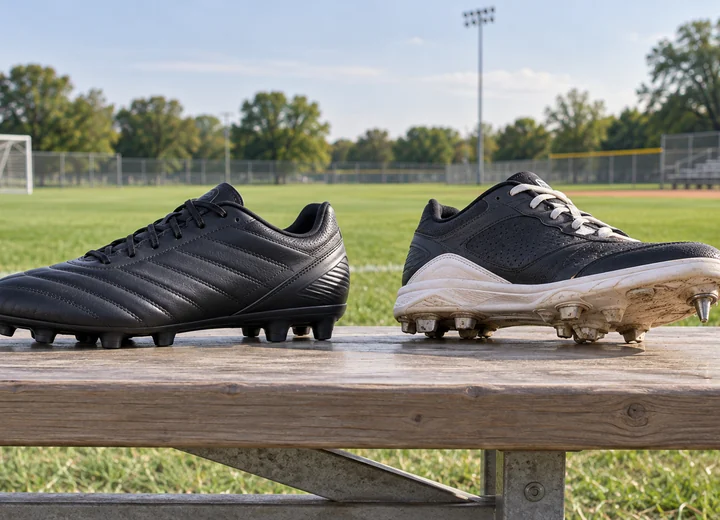
Turn the shoes over. Many baseball cleats have a distinct stud protruding near the very front of the toe. It helps with push-off on dirt and around the bases. Soccer cleats generally do not have that front toe spike because players kick, tackle and make close contact. Hospital for Special Surgery's cleat guide describes the baseball toe spike and the absence of a toe cleat on soccer shoes. Under Armour's comparison makes the same sport-specific distinction.
Do not decide from the shoe's side profile or a vague online title. Inspect the underside of the exact pair. A baseball model may also differ in stud material, height, upper stiffness and shape. Metal baseball spikes raise separate concerns and may be disallowed by a venue or age-group rule. A pair that lacks a prominent toe stud still needs a full field and equipment check; “no toe spike” does not automatically make it a soccer shoe.
| Feature | Typical soccer cleat | Typical baseball cleat |
|---|---|---|
| Front toe spike | Absent | Often present for baseball push-off |
| Primary playing environment | Soccer grass or specific artificial surface | Dirt infield and baseball outfield |
| Stud pattern | Chosen for a soccer field category | Designed around baseball movement and surfaces |
| Match decision | Still subject to safety and venue rules | Requires close inspection; do not assume approval |
These are typical design tendencies, not specifications for every model. Check the manufacturer page for the shoe in your hand.
What the soccer rules actually say
Do not repeat the blanket claim that international soccer rules name and ban every baseball cleat. IFAB Law 4 requires footwear and states that players must not use dangerous equipment. Officials inspect players before the match and can require a player to remove or replace equipment judged dangerous or unauthorized. The law does not provide a simple list of approved shoe models. A league, school, tournament or facility can also set more specific restrictions.
For that reason, the useful question is whether this exact pair is safe and permitted at this event. A prominent front toe spike, sharp metal edge, damaged stud or unsuitable traction pattern is a reason to stop and ask before entering play. The referee's on-field equipment decision and the competition's published rules matter. A friend saying they wore a similar pair last season is not a substitute for those checks.
Even if a local organizer allows a particular pair, it may still be a poor match for the pitch. The outsole must suit natural grass, artificial grass or indoor conditions as appropriate. Our FG versus AG guide explains why a surface label is a separate question from sport-specific shoe design.
How to inspect a pair you already own
- Identify the model. Find the brand and model code on the shoe or purchase record. Look up its intended sport and surfaces on the manufacturer's page.
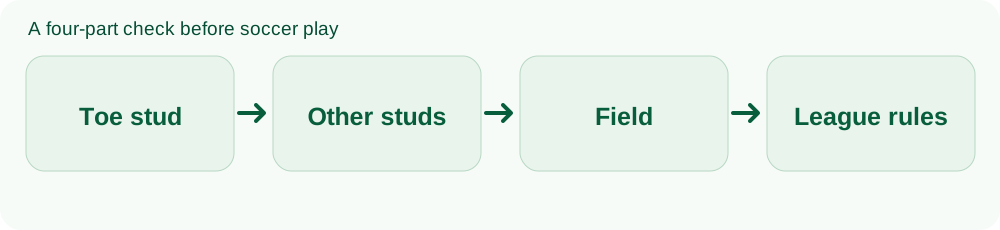
- Inspect the toe. Hold the outsole at eye level and look for a stud extending from the very front. Compare it with the front of a purpose-built soccer cleat.
- Check every stud. Look for metal, sharp edges, cracks, missing pieces and an unusually aggressive pattern. Do not file or cut studs in an attempt to make an unauthorized shoe legal.
- Confirm the surface. Ask the venue how it classifies the pitch and which studs it allows. A baseball shoe built for dirt may behave differently on soccer turf or grass.
- Ask the actual organizer. Send clear sole and side photos with the model name to the coach, league or referee contact before the game. Bring a suitable alternative if the answer is uncertain.
Do this before the match, not while the rest of the team is warming up. A refusal at the field can leave you without permitted shoes. The inspection does not certify safety; it helps you identify obvious mismatches and obtain the relevant ruling.
Why removing the toe spike is not a good fix
A stud is part of a designed soleplate. Cutting it off can leave a sharp remnant, expose material or change how the remaining outsole contacts the ground. It may also void product coverage. More importantly, modifying one front stud does not make the other studs appropriate for a soccer surface or satisfy a league's equipment rule. If you only have baseball cleats, ask to borrow an approved soccer pair in the correct size or use a suitable alternative the venue accepts.
Some players wonder whether switching to a molded plastic baseball model is enough. Plastic avoids one metal-spike issue, but the shoe may still have a toe stud and baseball-specific traction pattern. Inspect it the same way. A smooth-looking upper does not answer the underside question. The safest practical purchase for a new soccer season is a soccer shoe whose manufacturer lists the field you actually play on.
Children's equipment deserves the same attention. Youth baseball and soccer shoes can look similar at a glance. Parents should look at the sole before sending a child to practice, and ask the coach about both sport and surface requirements. Choosing a slightly larger shoe to reuse for two sports can also create sliding or toe impact; fit should be checked independently.
Choosing one or more pairs for two sports
If you play both baseball and soccer, first ask each organizer what is permitted, then compare the specific fields. Do not assume one sport's cleat will perform well or be allowed in the other just because the size fits. Baseball's dirt infield and soccer's continuous running and ball contact place different demands on an outsole. A soccer cleat might lack the front toe spike a baseball player wants, while a baseball cleat may present the soccer problems described above.
For occasional recreational play, ask whether the venue permits a turf shoe or another sport-appropriate, non-marking option. For regular competition, separate footwear is often the clearer decision. You do not need the highest-priced model in either sport; you need a permitted pair that fits each field. Keep the model information and venue rules so you can make the decision again if you change teams or facilities.
If ordering online, request a photo of the outsole and the model code. A listing that says “baseball/soccer” without showing the sole is insufficient. Check the return policy before wearing the shoe outdoors. You can also compare soccer and American-football cleats if you play multiple field sports; the designs differ for other reasons too.
Common questions
Are baseball cleats always banned in soccer?
Do not treat that as a universal wording of IFAB Law 4. The rule prohibits dangerous equipment; competitions and officials apply their own checks. Many baseball designs have a front toe spike that raises a clear concern.
Are plastic baseball cleats okay for soccer?
Plastic material alone does not settle the question. Inspect the toe stud and entire outsole, then verify the venue and competition rules.
Can I cut off the front baseball stud?
Do not do that. It can leave a sharp or damaged soleplate and does not establish that the remaining shoe is appropriate or permitted.
The practical answer
For soccer, choose a soccer shoe matched to the field. If you already own baseball cleats, inspect the front toe stud and the whole outsole, consult the organizer or referee, and bring a permitted alternative. The exact shoe and local rules decide the match-day answer.
Sources and scope
- Hospital for Special Surgery, cleat comparison
- Under Armour, soccer versus baseball cleats
- IFAB Law 4, players’ equipment
This guide combines published manufacturer guidance and editorial decision steps. It is not a hands-on test of a particular bootswave product. Product instructions and venue rules for your exact model take priority.
Ask about a product
You can ask about one pair or one jersey. Tell us the style, size, delivery country and your question; we can confirm options and price. Message bootswave on WhatsApp or use this form.
Published: · Updated:
