
JERSEY CARE GUIDE
How to Store Soccer Jerseys Without Damaging Prints
Store a soccer jersey fully dry in a cool, shaded place, with its name and number free from hard folds or pressure. A smooth hanger works for many current shirts; careful flat storage suits printed or collectible shirts when you can give them space.
By bootswave Editorial ·
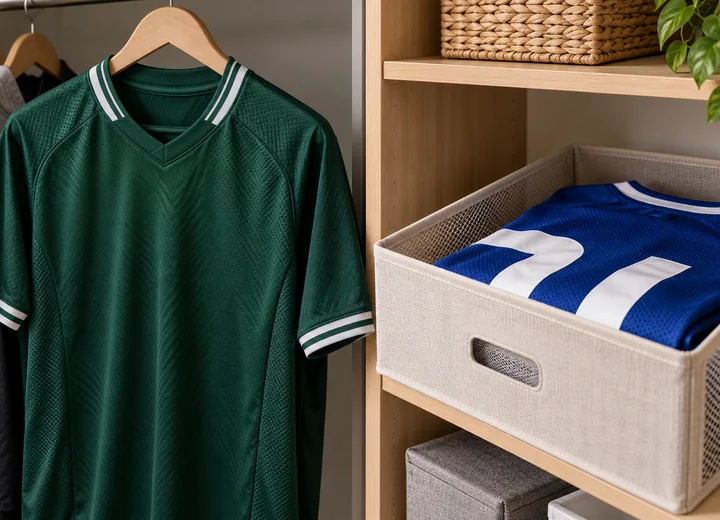
Store the shirt clean, dry and out of direct light
Do not put a sweaty or damp shirt straight into a box or closet for a long period. If it needs washing, check its own label and any decoration instructions first; a modern printed replica and an older match shirt may need different treatment. Let the jersey dry all the way through, including collars, cuffs, patches and thick transfers. Our jersey-washing guide covers the care decision before storage.
Choose a closet, shelf or drawer away from a sunny window, radiator and known damp spot. The Canadian Conservation Institute explains that light, heat and excess humidity can damage textiles over time. Its guidance is written for collections, so an everyday player need not recreate a museum storage room. The practical lesson is simpler: avoid sun, moisture and harsh heat. A recent jersey used weekly needs easy access as well as reasonable protection.
If a shirt smells musty or still feels cool and clammy, dry it in a suitable ventilated place before storage. Do not hide a moisture problem with a sealed bag. If you see suspected mould or damaged vintage fabric, ask a textile-care professional rather than washing or scraping it aggressively.
Hang or fold? Choose by condition and decoration
| Shirt and use | Practical option | What to avoid |
|---|---|---|
| Modern shirt worn regularly | Smooth, adequately wide hanger with room in the closet | Wire hanger, cramped rail or sunlight |
| Printed shirt stored for a season | Hang if supported, or fold loosely around the print | Sharp crease through nameset or sponsor |
| Fragile, older or valuable shirt | Flat, supported storage with suitable conservation materials | Heavy stacking, tight folds or casual washing |
Classic Football Shirts says it hangs used stock on non-wire hangers and keeps new stock folded in boxes; it warns against folding through namesets and sponsors because long-term creases may contribute to cracking or peeling. That is a retailer’s care practice, not proof that every decoration is identical. The full care note is useful when deciding between hanging and folding.
For a fragile collectible, the Canadian Conservation Institute recommends flat support for many textiles and padding unavoidable folds with suitable conservation materials. A regular fan shirt in active rotation does not necessarily need archival tissue. Use this higher-care route when the item’s age, rarity or condition makes damage difficult to reverse.
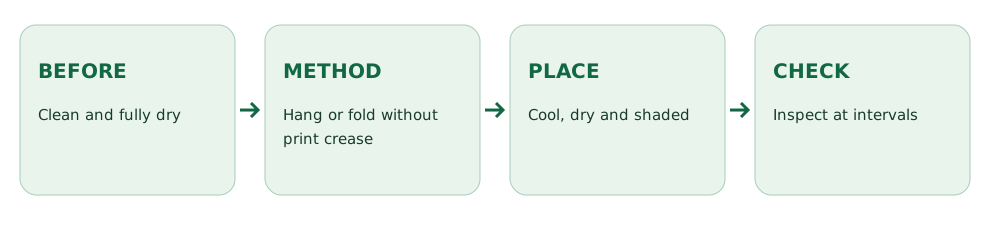
If hanging, support the shoulders and give the print space
Use a clean, smooth hanger that does not leave a sharp point at the shoulders. Avoid wire hangers that can rust, mark the fabric or give poor support. Leave enough room that the shirt hangs naturally rather than being pressed against coats or other jerseys. Keep the front or back decoration from rubbing repeatedly against rough hardware or a neighboring zipper.
Before hanging, inspect the shoulder seams. If the shirt is fragile, knitted loosely, heavily decorated or already stretched, flat support may be safer than hanging. The Canadian Conservation Institute makes this distinction for costume collections. For a recent polyester jersey, a normal smooth hanger and an uncrowded, dry closet are usually a workable everyday option, provided the garment’s own instructions do not say otherwise.
If using a garment cover, select one that allows appropriate air movement and does not trap a damp shirt. The CCI cautions against ordinary dry-cleaner plastic bags for long-term textile storage because they limit air circulation and do not protect from light. For ordinary jerseys, an uncovered shaded closet can be better than a sealed, wet-prone bag.
If folding, do not put the crease through the name or number
- Lay the fully dry jersey on a clean, smooth surface with the decoration visible.
- Check where the name, number, sponsor and patches sit. Plan folds through undecorated fabric where possible.
- Bring the sleeves inward gently without sharply bending a transfer.
- Fold the body loosely enough that the decoration is not forced into a hard corner.
- Place it in a clean drawer or box without heavy items pressing on top. Keep other clothing from catching on patches.
If the design makes a crease unavoidable, change the fold or use flat storage. For a valuable shirt kept for years, conservation-grade tissue can support a necessary fold; consult an experienced conservator if the material or print is already unstable. Do not place ordinary printed paper against a shirt for long storage, because its ink and surface were not selected for textile contact.
Not every box needs to be airtight. A clean, dry, shaded drawer is often enough for a modern shirt. If a storage box traps humidity, a technically “tidy” method can become the worse one. The main checks are dryness, light exposure, pressure on decorations and the shirt’s condition.
Handle a worn shirt differently from a collectible
A weekly match shirt may be washed, dried and returned to the closet often. Put it where it can air before the next session and inspect the print while doing normal laundry. A signed, old or match-issued jersey may be much more sensitive to washing, folding, handling and display light. Do not assume the washing routine that works for a current shirt is safe for it.
If the shirt has a signature, ink or aged transfer, avoid untested cleaning and handling. Photograph its current condition and ask a specialist about appropriate storage if its value matters. Our framing guide covers display decisions; display is a different task from dark storage and adds light and mounting considerations.
For a collection of several jerseys, label a box or use a simple inventory so you can find a shirt without repeatedly unfolding every piece. This is an organizational suggestion, not a preservation treatment. Make sure labels or adhesives do not touch the textile.
Check the shirt after storage
Every so often, look for a new crease through a transfer, lifting print edge, discoloration, moisture smell or a stressed shoulder. If you notice a problem, change the storage condition rather than pressing harder on the same fold. Check the room as well: direct light may shift with the season, and a previously dry cupboard can become damp.
If a transfer has started to peel, avoid household iron experiments on a valuable or old shirt. Heat and pressure can worsen some materials. Follow the maker’s specific repair advice, or consult a specialist for a collectible. The safest preventive step is to keep hard folds and heavy stacking away from decorations from the outset.
Common questions
Is it better to hang or fold soccer jerseys?
Either can work for a current shirt. Use a smooth hanger with shoulder support, or fold loosely without a crease through names and numbers. Fragile or valuable shirts often benefit from flat support.
Can I leave a jersey in a plastic bag?
Do not seal a damp shirt in plastic. For long-term storage, ordinary dry-cleaner plastic bags are not recommended by textile-conservation guidance. A clean, dry, shaded space with suitable air movement is a better starting point.
How do I store a signed soccer jersey?
Avoid unnecessary washing, bright display light, hard folds and direct contact with untested materials. If the signature or shirt has significant value, ask a textile professional for item-specific storage advice.
Summary
Dry the jersey completely, choose a hanger or fold that supports its condition, keep hard creases away from prints, and store it away from direct light and damp. Inspect it periodically so a small storage problem does not continue unnoticed.
Sources and scope
This guide uses published manufacturer, sporting-body or textile-care guidance and editorial decision steps. It is not a hands-on test of a particular bootswave product.
Ask about a product
You can ask about one pair or one jersey. Tell us the model or style, size, delivery country and your question; we can confirm options and price. Message bootswave on WhatsApp or use this form.
Published: · Updated:
